Get Full Government Meeting Transcripts, Videos, & Alerts Forever!
Get email alerts on the Municipal Service Reviews topic
No spam. Unsubscribe anytime.
LAFCO accepts draft South County MSRs for Woodside and Portola Valley, schedules final hearing for Jan. 21, 2026
Summary
San Mateo County LAFCO reviewed circulation drafts of municipal service reviews for Woodside and Portola Valley, highlighted sewer capacity limits and a rising sheriff contract that is driving budget gaps, accepted the drafts and directed staff to schedule final hearings for Jan. 21, 2026.
The San Mateo County Local Agency Formation Commission on Nov. 19 accepted circulation drafts of municipal service reviews for the towns of Woodside and Portola Valley and directed staff to schedule final public hearings for Jan. 21, 2026.
Rob Bartoli, LAFCO executive officer, told the commission that Woodside’s general fund is currently balanced but faces an “approximately $1,000,000 gap” in fiscal years 2030–31 between sheriff contract costs and expected general-fund revenue, and recommended the town study options such as reserve use, new revenue or reduced service levels. Bartoli also noted that much of Woodside relies on septic systems and that the town lacks its own treatment plant, making it dependent on treatment allocations from other agencies.
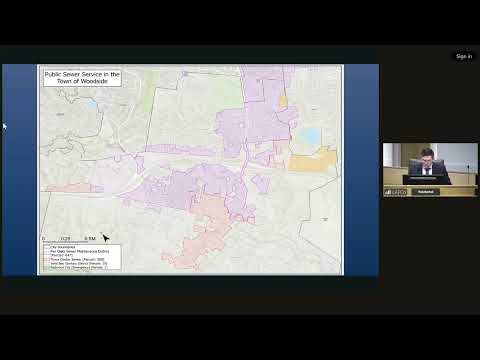
The MSR presentation flagged sewer-service constraints in Woodside — multiple providers serve portions of the town (the town, West Bay Sanitary District and Fair Oaks County maintenance district) and treatment is routed to Silicon Valley Clean Water in Redwood City. Bartoli recommended regular coordination with Fair Oaks and the county, monitoring of sewage flows against contract limits and a townwide or area-specific sewer feasibility study to prioritize sites identified in the housing element.
Jason Ledbetter, introduced as Woodside town manager, said the town recently approved a contract for a sewer capacity and sewer master plan study and that the town-center allocation is about “100,000 gallons a day” while another sewer service area is about “150,000 gallons a day,” figures the study will test against housing-element sites.
On Portola Valley, Bartoli said the town has carried a structural general-fund deficit since 2021–22 and that the sheriff’s contract rose by 59% for 2023 services; absent new revenue measures the town’s reserves could be in deficit by fiscal year 2029–30. Darcy Smith, identified as Portola Valley town manager, said the town’s community survey found favorable initial support for a real-estate transfer tax; she said a proposal of $10 per $1,000 of sale price would “generate approximately 2,000,000 per year,” and that placing a charter amendment and transfer-tax measure on the ballot could allow revenue collection beginning Jan. 1, 2027 if voters approve it.
Bartoli told the commission staff is not recommending a particular governance action. He reviewed governance options discussed in the report — annexation of adjacent unincorporated areas, consolidation into a single successor city (no precedent in California), and disincorporation — and said the report lists those options for public information rather than as staff recommendations.
The commission accepted the draft MSRs and then voted unanimously to direct the executive officer to circulate drafts to affected agencies, schedule virtual public workshops as needed and set a final MSR hearing for Woodside and Portola Valley on Jan. 21, 2026. The motions passed on roll calls with unanimous affirmative votes.
Next steps: staff will circulate the draft reports to county, city and special-district stakeholders, coordinate outreach and return to the commission on Jan. 21, 2026 for final determinations.