
Committee forwards ethics and disclosure changes to Committee of the Whole after debate over $1,500 cap, city seal and vendor disclosures
Get AI-powered insights, summaries, and transcripts
Subscribe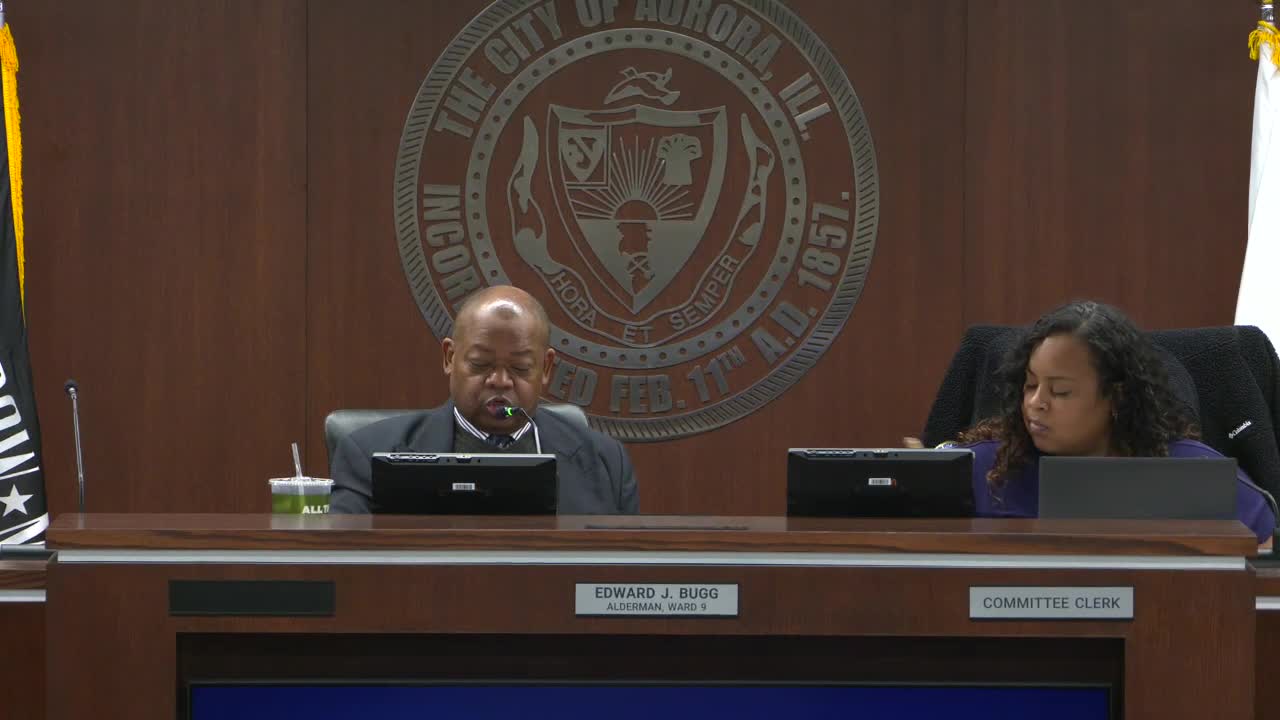
Summary
The committee forwarded an ordinance amending Aurora's disclosure rules to Committee of the Whole by a 3-1 vote. Staff said the Dec. 2 draft raises the individual contribution cap from $500 to $1,500, removes cash-donation rules and omits city property/seal language; members debated petition-related disclosure, vendor notices, a proposed four-year vendor ban, and possible limited exemptions for city facilities.
The Rules, Administration & Procedure Committee voted 3-1 on Dec. 2 to forward an ordinance (item 25-0779) that would amend multiple sections of Aurora's Code of Ordinances governing disclosure of economic interests, campaign contributions, lobbying and the use of city property and the city seal.
Shannon Cameron, chief of staff, summarized the key changes in the Dec. 2 draft: "We changed the contribution limit was 500 to $1,500 based on your feedback from last meeting. We eliminated the rules for cash donations, and we removed the regulations around city property and the seal." Cameron said Exhibit A is the current draft and Exhibit B the prior draft.
Committee members probed several aspects of the draft. They discussed whether the city's disclosure requirement should apply to individuals circulating petitions (state law defines the start of candidacy at the receipt of the first petition signature). Cameron said staff recommended aligning the city definition with state law but said the committee could revert the language; the stated aim was to prevent businesses doing business with the city from making large donations to prospective candidates in the pre-petition period.
Members also questioned the decision to remove restrictions related to the city seal and city property. Several members said wearing city-branded attire at community events is common and that overbroad language could complicate legitimate civic activity; Cameron and the committee discussed carving out narrow exceptions (for example, for renting city facilities such as the golf course or pavilion) while preserving the ordinance's intent to separate campaign activity from official city functions.
A substantial portion of the discussion focused on vendor disclosure and enforcement. Committee members asked whether vendors should be required to disclose prior donations when applying for city contracts and how a proposed four-year ban for violations would be enforced and communicated. Staff said vendor disclosure is currently handled differently depending on the procurement process and that adding disclosure questions to RFPs or vendor packets could be considered, but cautioned about First Amendment issues and asked for more legal review. Several members urged clearer vendor education materials and a practical enforcement process.
The committee voted to forward the ordinance, with staff'reported changes, to the Committee of the Whole for additional review and minor cleanup; the transcript records a 3-1 committee vote (one dissent recorded verbally as "Me" during roll call without an explicit name stated on the record). Cameron and committee leadership said they would return with cleanup language addressing limited exceptions, vendor-notice details and educational steps for implementation.
Next steps include legal review of vendor-disclosure language, drafting any narrow exceptions for use of city property, and preparing staff materials for vendor education and procurement packet updates before Council-level consideration.