Get Full Government Meeting Transcripts, Videos, & Alerts Forever!
Get email alerts on the Budget topic
No spam. Unsubscribe anytime.
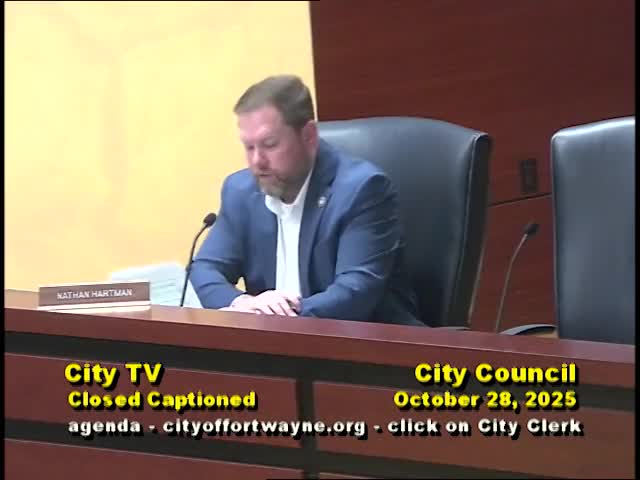
Fort Wayne Common Council adopts 2026 budget after targeted cuts, narrowly approves $1 million reduction for Southeast plan
Summary
After hours of debate and a series of friendly withdrawals, the Fort Wayne Common Council adopted the 2026 civil city budget as amended, approving a contested $1,000,000 cut to Southeast implementation on a 5-3 vote while preserving many multiyear commitments such as Arts United.
The Fort Wayne Common Council voted to adopt the city's 2026 civil city budget as amended after a lengthy committee review and full-council session on Oct. 28, 2025, approving a package of department cuts, carryovers and policy clarifications to close the gap caused in part by state-level changes to local tax distributions.
Pat (Pat Roller), who presented the administration's summary of the new budget rules caused by Senate Bill 1 and the current numbers, told the council that combining property and income tax revenue for planning was a major change and outlined the administration's view of the fiscal picture. The administration's presentation described a structural gap that the council addressed with a mix of cuts, one-time cash use and reallocation of other local funds.
Council members approved several individual reductions during the session, including a $775,000 materials-and-supplies reduction for the Police Department and a $35,000 cut to the Sports Development grant for Visit Fort Wayne. A proposed $600,000 commitment reduction for Science Central was amended to $300,000 and approved. A proposed $500,000 operating cut to Arts United failed after members said the city had made a multi-year commitment and private and county funding had leveraged earlier investments.
The most contested action was a $1,000,000 reduction to the Southeast implementation line. Proponents argued the smaller, combined cut was necessary to reach a cash-neutral plan and noted that Google-related supplemental payments and TIF receipts could be used to bridge timing gaps. Opponents said LIT (local income tax) funds had been prioritized for Southeast for years and that cutting the line would undermine community trust and slow agreed projects. The council approved the $1,000,000 reduction on a 5-3 roll call.
Councilwoman Amber Chambers, who emphasized the budget's role in protecting public-safety positions and neighborhood investments, said the proposal was "lean" but urged care with multiyear commitments. "The 2026 budget remains lean, preserving every public safety position, and continuing critical neighborhood investments," Chambers said during her presentation to the council.
The council passed the main civil city ordinance (A250925) as amended during the meeting and approved several related ordinances and resolutions for utilities, public works contracts and salary schedules. The meeting record shows multiple motions withdrawn or modified after staff clarifications about TIF eligibility, grant timing and carryovers.
Votes at a glance - A250925 (2026 Civil City budget, as amended): passed (final tally recorded in the meeting recap). - Southeast implementation: $1,000,000 cut — passed 5-3 (roll call). - Police materials-and-supplies reduction ($775,000): approved (voice/roll). - Sports Development grant cut ($35,000): approved 5-3 (roll call recorded in transcript). - Science Central commitment amended to $300,000: approved (voice/roll). - Arts United operating cut ($500,000): failed (vote recorded as 3-5 against the cut). - Various public works and utility contracts (Illinois Road, water-main replacements, filtration plant upgrades): approved by committee roll calls as noted in the minutes.
What happens next The budget ordinance takes effect as specified in the ordinance language; multiple departments and the administration will implement the cuts, carryovers and prioritization work discussed during the session. Council members asked the administration to return with clarifications and to identify potential supplemental revenue (including Google supplemental payments and redevelopment capital) that could be used to avoid delaying other redevelopment projects.