
Cowlitz County health officer: rare Washington H5N5 human case, public risk remains low; biosecurity urged
Get AI-powered insights, summaries, and transcripts
Subscribe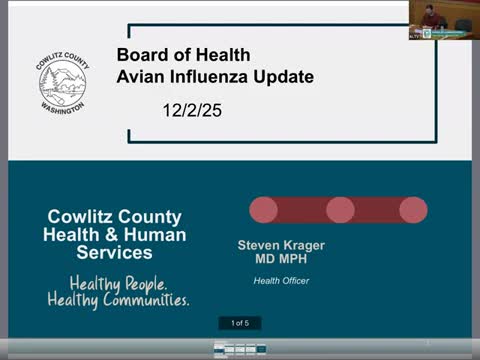
Summary
Cowlitz County Health Officer Dr. Steve Krager told the Board of Health that a rare human H5N5 case in Grays Harbor likely came from a backyard flock and that public risk remains low. He and WSU Extension advised biosecurity for backyard flocks, PPE for poultry workers and hygiene measures.
Cowlitz County Health Officer Dr. Steve Krager told the Board of Health the county is monitoring a rare human infection tied to avian influenza and urged residents to practice basic biosecurity and hygiene.
Dr. Krager said the recent Washington case involved an H5N5 strain and that the person — an elderly individual with underlying conditions — was likely exposed to an infected backyard flock. "The risk remains quite low," he said, adding that there is no evidence the virus has spread from person to person in that investigation.
The board heard that avian influenza primarily affects wild birds and poultry; the term "highly pathogenic" describes severity in birds rather than humans. Krager described how outbreaks can produce rapid die-offs in flocks and said large culling operations have occurred in past outbreaks where hundreds of thousands to a million birds may be affected. He warned that poultry and dairy workers involved in culling or cleanup face higher exposure and should use appropriate personal protective equipment.
Board members and the public asked for practical precautions. Krager recommended avoiding direct contact with sick or dead wild birds and contacting the park or the Washington Department of Fish and Wildlife if a dead wild bird is found. He advised backyard flock owners to practice biosecurity — secure coops, limit contact between domestic and wild birds, clean hands after interacting with bird baths or feeders — and said adding a roof or cover to a coop can be a reasonable protective measure.
On household animals, Krager said cats appear more susceptible in some outbreaks and have died in past incidents; dogs have not been reported to die from these infections in the county's examples. "Wash your hands," he said during question-and-answer as a simple, effective recommendation.
Jennifer Leach of Washington State University Extension told the board that 4-H and county extension staff are sharing guidance from the state 4-H leader and that extension will point leaders to state Department of Agriculture materials. "We are saying within the realm of 4-H and extension is really refer to the Department of Ag's website because they have lots of materials," Leach said, and reminded fair organizers of past practices that limited live poultry at events.
Board members did not take formal action on the briefing. The health officer said state and local agencies continue genomic and contact-tracing work to detect any change that would enable human-to-human transmission; none has been documented in the recent case. The board advised residents to report dead wild birds to authorities, maintain distance from wild birds, follow Department of Agriculture guidance for 4-H and fairs, and seek medical care if they become ill after poultry exposure.
The Board adjourned after further agenda items and will reconvene in late January 2026.