
Lawrence committee tables ordinance to align police, fire accruals pending fiscal analysis
Get AI-powered insights, summaries, and transcripts
Subscribe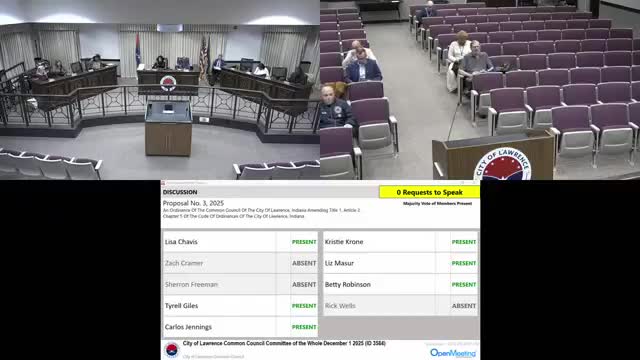
Summary
A committee hearing on ordinance No. 3, 2025 to align city code with police and fire CBAs (changes to accrual timing, sick/holiday carryover and bereavement leave) ended with the council tabling the measure and asking the comptroller and consultants for a detailed cost estimate.
Nick Grama, district vice president for Lawrence Professional Firefighters, told the council committee that proposed ordinance No. 3, 2025 would align city code with negotiated police and fire collective bargaining agreements and restore functional access to leave for employees hired after Jan. 1, 2019. Grama said the proposal does not increase annual leave amounts except in limited carryover caps for post‑2019 hires and includes repayment provisions for any unearned, front‑loaded time.
The proposal would leave post‑2019 employees accruing monthly but make the total annual accrual available on Jan. 1; raise sick leave carryover for post‑2019 hires from 200 to 600 hours; increase holiday rollover for post‑2019 hires (discussed in the hearing as moving from 96 to roughly 250 hours); and expand bereavement leave definitions and hours (Grama cited "72 hours for fire and 51 hours for police"). "We're just asking for them to be allowed the full allotment in January so that they can use their time," Grama said.
Councilors repeatedly pressed for a fiscal analysis. Several members said they could agree with the principles behind the changes but could not approve them without estimates of carrying costs and the financial exposure if employees separate after receiving front‑loaded time. "Let's get the numbers," Councilor Jennings said, summarizing repeated requests that staff and the city comptroller provide a cost estimate before advancing the ordinance.
Committee members also asked whether federal protections such as FMLA and short‑ or long‑term disability would cover long medical leaves; presenters said such protections exist but that post‑2019 hires frequently lack an available bank of paid time in January to bridge recovery periods without exhausting leave. Councilors suggested alternatives to front‑loading (for example, PTO borrowing or targeted benefit changes) and urged advocates to return with prioritized, costed proposals.
A representative from the administration said the item had been negotiated previously and "predates me," explaining that the commitment to bring the ordinance to the council came from a predecessor. The committee called forward the city's controller, who said they had just received the memo and could not provide an immediate estimate at the meeting.
An amount cited in the discussion as the historical payout liability for the department was described by a speaker as "three and a half billion dollars"; that figure was presented as an estimate in committee and was not accompanied by an audited or official calculation in the record.
With no cost estimate available, the committee approved a motion to table the ordinance until staff, the comptroller and any relevant consultants (Councilors suggested contacting Baker Tilly, which participated in earlier negotiations) provide a credible fiscal analysis. The motion to keep the item in committee was presented by "Christie" and the committee voted to table the item. The item will be moved to the next council meeting once financial figures are provided.
Next steps: the committee asked staff to obtain the financial analysis from the comptroller and any consultant files (including Baker Tilly) and requested the ordinance return to committee or be placed on the council agenda with the necessary cost information.