Residents, business groups press Glendale council to remove CORO designation and protect Montrose parking lots
Loading...
Summary
Dozens of residents, business leaders and callers asked the Glendale City Council to agendize removal of the CORO designation from the land‑use element and to strip surplus‑land status from several Montrose parking lots; council members agreed to place the matter on a future agenda for further review.
Dozens of residents, neighborhood associations and business representatives urged the Glendale City Council to remove a planning designation referred to in the meeting as "CORO" from the land‑use element and to rescind surplus‑land designations on multiple downtown parking lots.
The most prominent request came from Andre Ordubeygian, president of the Montrose Shopping Park Association, who asked the council to put a CORO removal item on next week’s agenda and to direct staff to begin removing surplus‑land designations from city‑owned lots used by merchants and residents. Paul Karapetian of the Royal Canyon Property Owners Association said five petitions — which he described as totaling about 5,000 signatures — back the community request and said he had heard that the community‑development director and deputy director of long‑range planning had publicly supported removing the CORO designation.
Supporters made similar appeals throughout the first public‑comment period and via callers: Patrick Massey (Verdugo Woodlands Neighborhood Association), Rima Cameron (Royal Canyon HOA), callers Nora, Edmond Gazarian and Dennis Fitoza (a congressional candidate) all urged immediate action to protect parking near Montrose, Verdugo Road and Canada Boulevard from redevelopment.
The appeals combined two distinct but related requests: remove the CORO designation from the land‑use element (a planning classification cited by several speakers) and remove specific city lots from the state surplus‑land process so they remain available for parking and recreation rather than being offered for development.
Greg Astorian of the Glendale Association of Realtors offered background data during the same period, saying the city permitted roughly 4,200 residential units over the past decade and netted about 4,000 built units — about 2.1 units per 1,000 residents. Astorian argued that by several institutional benchmarks that pace is modest and does not support the perception that development here is "too fast." He framed his remarks as an analysis of permit volumes, and council members questioned comparisons to statewide numbers.
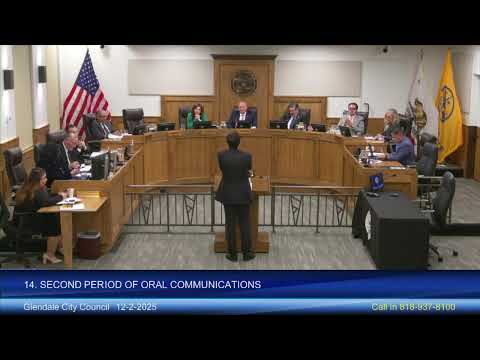
Council members responded to the public requests by moving to agendize the CORO/surplus‑land question for the next meeting so the council can determine whether three votes exist to place it on future agendas. Mayor and council asked staff (Mister Galanian and Mister Calvert) to provide timeline materials and to retrieve prior reports such as Vision Montrose so stakeholders and context can be brought to the discussion. The city attorney was asked to review procedural rules on motions to reconsider given prior council actions.
The council did not take a final vote on policy changes during the meeting; it instead agreed to continue the matter and seek staff briefings and background materials before any formal decision.
Speakers quoted in this article were recorded in public comment and represent the positions they expressed at the meeting.