
Salinas begins multi‑phase zoning code update; staff proposes technical advisory committee and broad outreach
Get AI-powered insights, summaries, and transcripts
Subscribe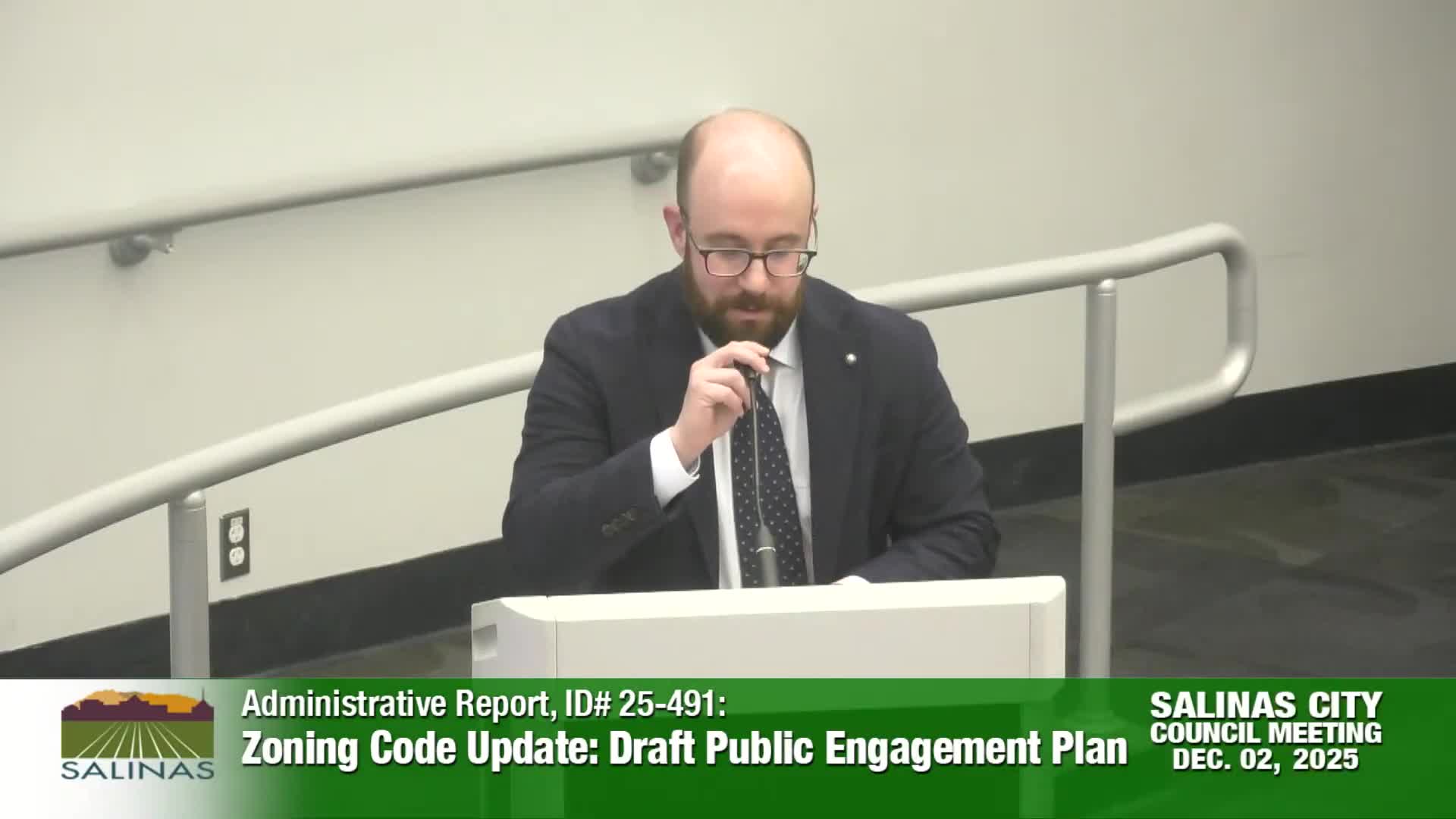
Summary
City staff announced a multi‑phase zoning code update to align the municipal code with the recently updated general plan and state housing law. Phase 1 will prioritize compliance with state housing requirements; staff proposed a 15‑member technical advisory committee, quarterly council updates and public workshops in early 2026.
Jonathan Moore, presenting the zoning code update framework, told council the city is beginning a multipart effort to revise Chapter 37 of the municipal code — the city’s comprehensive zoning code — for the first time in nearly two decades. Moore described three phases: Phase 1 (updates to comply with state housing law and address accessory dwelling units, approval standards and design standards) is already starting and is expected to wrap in 2026; Phase 2 will align the zoning code with the updated general plan later in 2026; Phase 3 will produce a full code rewrite with a target of 2027.
Moore said PlaceWorks was selected as consultant and will support public engagement planning. He proposed forming a technical advisory committee (TAC) of roughly 15 technical users (builders, architects, SPARC, Chamber, Central Coast Builders, Monterey County Association of Realtors and others) and recommended the planning commission remain the primary advisory body providing formal recommendations to council.
Councilmembers pressed staff on TAC accessibility, whether TAC meetings will be videotaped and how nontechnical residents can be included. Moore and the city manager said TAC meetings would be open to the public but are not Brown Act bodies and typically are held in community spaces; staff proposed additional public workshops, pop‑ups and a Saturday kickoff workshop in early 2026 to broaden outreach and suggested a public call and application process for TAC seats.
Public commenters and SPARC urged that substantial outreach precede drafting (community‑first approach) so that drafting reflects community vision. Staff said the engagement plan is a flexible framework designed to be adapted and will include targeted outreach to seniors and to residents who are blind or deaf. No formal action was required; staff will return with implementation details and timing for the first public workshop.