
Saint Helena planning commission forwards Spring Grove map to council, approves demolition permit amid stormwater and affordability concerns
Get AI-powered insights, summaries, and transcripts
Subscribe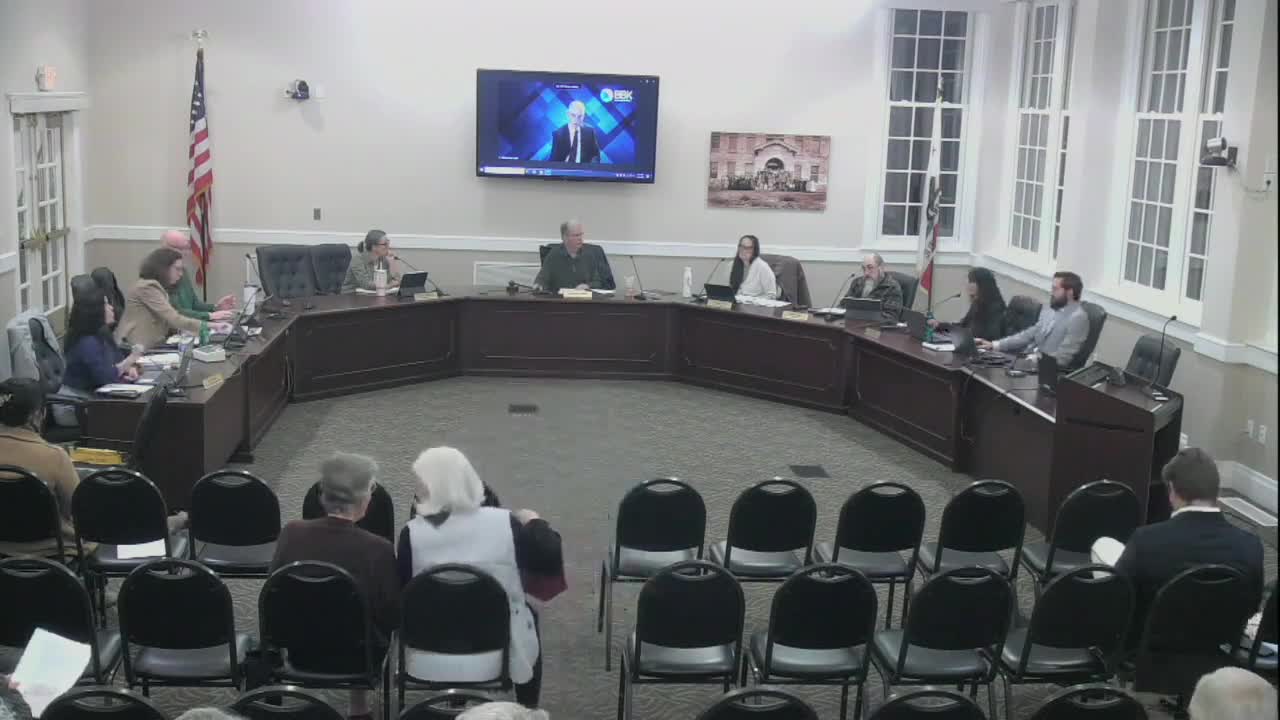
Summary
The planning commission voted 4-0 to recommend the Spring Grove vesting tentative map to city council and approved a demolition permit for three homes. Residents pressed staff and the developer on stormwater design, emergency access, tree protection and whether deed‑restricted units will be affordable to local workers.
The Saint Helena Planning Commission on Dec. 2 voted unanimously to recommend the vesting tentative map for the Spring Grove housing project to the City Council and to approve a demolition permit for three existing homes, amid extensive public comment raising technical and affordability concerns.
The 2.53‑acre Spring Grove site on Spring Street (parcels at 1447, 1505 and 1515 Spring) is proposed as a 41‑unit townhome development with private streets, private utilities and two on‑site bioretention stormwater facilities. Staff said the proposed density is 16.2 units per acre and that the developer would provide eight deed‑restricted units (20% of the project) to satisfy the city’s inclusionary requirement. The commission’s recommendation on the tentative map now goes to the City Council for final action; the demolition permit for the three homes was approved by the commission itself.
Why it matters: supporters say Spring Grove fits the city’s housing‑element site designation and will add missing‑middle homes near downtown, while neighbors say the technical record is incomplete and the project as proposed risks off‑site flooding, inadequate emergency access and will not be affordable to many local workers. The issues raised could shape conditions the council imposes during its review.
Staff and applicant overview Mike Janacek, the consultant planner presenting the staff report, said the application includes a vesting tentative subdivision map (41 condominium airspace units) and a demolition permit for three dwellings. Janacek told commissioners the project has undergone multiple reviews and that a minor design review was approved administratively on Nov. 21. He described the project’s private infrastructure, including three private streets (28 feet narrowing to 26 feet), private domestic and fire water lines, private sewer and storm drains, two bioretention facilities, and a proposed private lift station to convey treated stormwater to the public system on Spring Street.
Kelso Barnett of City Ventures, the applicant, described the project as ‘‘missing middle’’ townhomes aimed at first‑time homebuyers and young families, stressing walkability and sustainability features. Barnett said the developer intends the deed‑restricted units to be marketed to lower AMI tiers and that the market units would still price below Saint Helena’s median home value.
Technical and safety concerns from residents Many residents urged the commission to require more engineering detail before forwarding the map. Architect and resident Wayne Leong presented a technical critique, calling out what he described as incomplete stormwater design (no overflow routing, unspecified lift‑station backup power, and potential direct discharge to the creek). He told the commission: "When developers pay an in‑lieu fee that adds to nothing, they leave the project, and then everyone's stuck with the consequences." Leong asked the commission to direct the applicant to provide corrected density analysis, complete stormwater overflow routing, a detailed fire access analysis and a viable water neutrality plan before moving forward.
Other commenters raised related concerns: Pat Friday said runoff from Spring Street already burdens downstream ponds and flagged a large oak tree near proposed retention basins; Clark McCormack, a contractor, challenged the site circulation and ability for aerial apparatus to operate safely in narrow private drives; Dan Hale and others questioned elements of the historic‑resource evaluation and the density calculation method for the three‑parcel site.
Staff and fire/public‑works response Staff acknowledged some engineering details are not depicted on the tentative map plans and pointed to draft conditions (including condition 54) requiring the applicant to demonstrate compliance with Bay Area Stormwater Management Agency Association (BASMAA) standards and the municipal code prior to building‑permit issuance. Assistant public works and the city’s counsel reiterated that final engineering for stormwater and drainage would be required before building permits are issued.
Alec Vidler, the fire inspector, said the plan provides 28‑foot drives that narrow to 26 feet and that those widths meet aerial apparatus access standards if buildings are fully sprinklered. He noted code language that can allow a single access when units exceed 30 but the buildings are fully sprinklered, meaning a second access road is not automatically required if the sprinkler exception applies.
Affordability and buyer access Throughout public comment, residents expressed skepticism that the deed‑restricted units would be affordable to local workers. Applicant Kelso Barnett said the eight deed‑restricted units would be offered under the city’s standard affordability mix (four at 100% AMI and four at 120% AMI) and gave estimated price ranges: deed‑restricted units in the low‑$400,000s to roughly $525,000–$550,000 for higher AMI tiers; market units were estimated in a range reaching roughly $900,000 to $1.1–$1.2 million, depending on size and market conditions. Barnett and public commenters discussed possible local programs (‘‘silent second’’ down‑payment assistance, deed restrictions targeted to local buyers) to increase chances that local families can buy into the project, but the commission noted it cannot condition the tentative map on private financing arrangements.
Commission action and next steps After extended public comment and staff responses, the commission deliberated. On a motion, the Planning Commission voted 4‑0 (Commissioners Anderson, Lopez, Covell and Chair Warner) to recommend that the City Council adopt the vesting tentative map for Spring Grove (file TSM25‑001) and to forward the draft resolution and recommended conditions. Separately, the commission adopted the demolition‑permit resolution (also 4‑0). The council will consider the tentative map and the city’s authorization for any water neutrality in‑lieu fee, and additional technical submissions will be required as conditions of later approvals (building permits/final map).
What’s next: city council hearing and permit submittals The commission’s recommendation goes to the City Council, which has final authority on the subdivision map and on authorization of any water neutrality in‑lieu fee. Staff will require the applicant to provide full engineering details (stormwater overflow routing, lift‑station design, drainage/erosion controls) prior to building permit issuance; the fire department and public works will confirm compliance with applicable codes at later permit stages. The commission also reminded the public about a zoning code study session on Dec. 16 where broader policy questions (objective standards, water neutrality and how the code is working) will be discussed.
Reported vote counts The tentative‑map recommendation was forwarded to council on a 4‑0 roll‑call vote (Anderson, Lopez, Covell, Warner — yes). The demolition permit was adopted by the commission on a 4‑0 roll‑call vote.
The Planning Commission meeting was adjourned.