
Consultants tell Martin County commissioners Indian River Lagoon provides billions in annual value and high ROI for restoration
Get AI-powered insights, summaries, and transcripts
Subscribe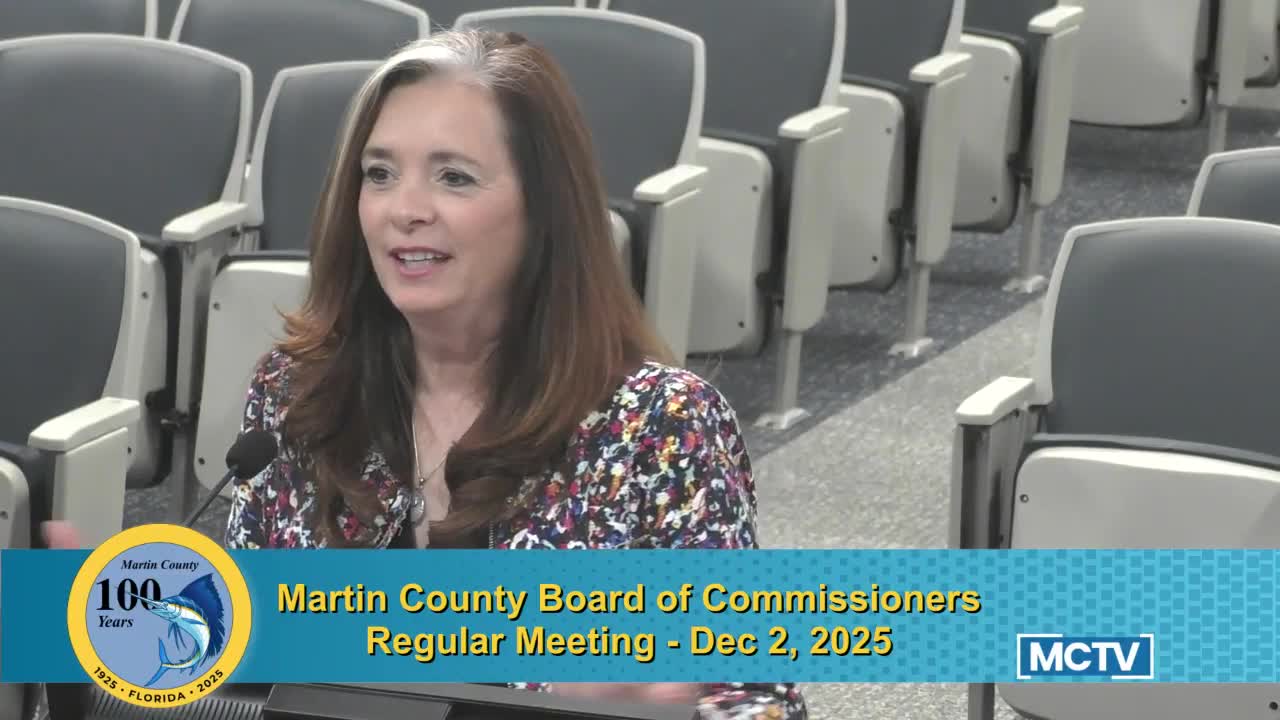
Summary
Presenters using the InVEST model told the Martin County Commission the Indian River Lagoon generates more than $10 billion a year in ecosystem service value, supports roughly 128,000 jobs regionally and yields very high estimated returns on restoration spending (about 24x overall).
Valerie Seidel, a researcher who has worked with the Indian River Lagoon National Estuary Program, told the Martin County Commission the updated lagoon economic valuation finds more than $10 billion per year in ecosystem-service value across the lagoon and broad local benefits for Martin County.
Seidel said the analysis used the InVEST model and detailed land-cover mapping to estimate services such as flood-water storage, coastal protection, water filtration, habitat, recreation and property-value premiums. "That's water that would otherwise be in our homes and our roads," she said when describing natural flood-water retention.
The presentation included several headline figures: preserved lands across the lagoon retain more than 100,000,000,000 gallons of flood water annually; about 52,000 acres provide coastal protection that Seidel estimated generates roughly $250 million a year (NOAA-funded projects under way could add about $8.4 million annually); and roughly 360,000 acres provide water filtration that produces more than $500 million in public value (NOAA projects estimated to add about $38 million). Seidel said wildlife-habitat values add roughly $1 billion annually and that values vary by sub-basin from hundreds of thousands to tens of millions of dollars.
Seidel explained how the team translated proximity to lagoon features into property-value premiums. She cited county examples: being close to the lagoon adds about $350,000 to average sales price in parts of Brevard County and nearly $1,000,000 in parts of Palm Beach County. For Martin County, Seidel said waterfront properties account for just over $3,000,000,000 in added value, which annualizes to roughly $350,000,000 in flows to local coffers.
The consultants also ran benefit–cost examples of 10-year restoration projects by habitat type. Seidel said some transformational projects (for example, removing impoundments to restore fish passage) produced exceptionally high returns; overall, the selected projects produced an estimated return of about $24 for every $1 invested, and roughly 10x when the largest outliers are excluded.
Using a conventional economic-impact approach to measure spending and multiplier effects, Seidel reported lagoon-wide value added of about $15 billion per year, total output near $26.9 billion and support for about 128,000 jobs with roughly $8 billion in total payroll. For Martin County specifically she cited roughly 15,000 direct jobs, about $800 million in payroll and about $1.4 billion added to the local economy; she also reported about $124 million in state and local taxes and about $176 million in federal taxes annually attributable to lagoon-related activity.
Seidel said the project team published an interactive dashboard so officials and residents can view and slice the data (most series cover 2012–2022; some begin in 2019). She said the analysis used conservative, lower-bound estimates throughout and invited commissioners to ask questions and use the dashboard for local planning.
Commissioners praised the presentation and urged staff to continue public messaging about the lagoon's economic benefits and the value of restoration investments.