Get Full Government Meeting Transcripts, Videos, & Alerts Forever!
Get email alerts on the Code Enforcement topic
No spam. Unsubscribe anytime.
Spokane County prosecutors propose civil nuisance enforcement, $250/day fines and private-camping ban on unincorporated land
Summary
Spokane County Prosecuting Attorney's Office presented code amendments to create a civil-infraction regime and a code enforcement officer to address nuisance properties, plus a private-property long-term camping ordinance; staff will amend camping duration language and hold a public hearing Dec. 16.
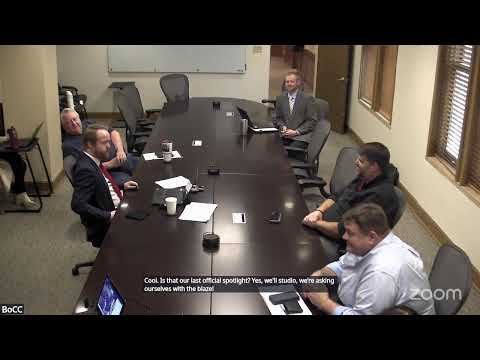
Spokane County prosecutors briefed the Board of County Commissioners on proposed changes to county code intended to make nuisance enforcement faster and civil rather than criminal. Jameson Dumo of the Spokane County Prosecuting Attorney's Office said the rewrite would centralize violations (zoning, building) into a nuisance framework, authorize a dedicated code enforcement officer, and allow civil infractions and abatement actions.
Dumo said the civil-infraction tool would give staff "a notice of violation" and, if property owners fail to comply, allow issuance of civil infractions assessed at "$250 a day per violation every day that that violation exists." He described voluntary abatement agreements as an option for owners who engage with the county; if an abatement is performed by the county, staff can file a special-assessment lien on the property to recoup costs.
The presenters told commissioners the goal is to decriminalize many nuisance-related matters so they do not add to criminal caseloads and to use a lower civil burden of proof. Dumo said statutes cited in the briefing provide authority for the changes and that the prosecuting attorney's office would have discretion to file abatement actions without returning to the board in each case.
Commissioners pressed for detail on definitions and due process. Staff said the revised language uses a broad nuisance definition (activities that "interfere with the quiet enjoyment of your neighbor") and that property owners could contest infractions in district court; superior court would address warrants of abatement. Scott Simmons and Kyle Tewig were named as staff collaborators on proposed funding approaches.
On private-property camping, staff presented an ordinance limited to the unincorporated county that would target "long-term" camping, originally defined in the draft as more than 14 consecutive days (stated as "14 days within any 30 day period" in the briefing). The ordinance would not regulate public camping, permitted camping in parks, or religious hosting covered by state statute. Commissioners raised concerns that a 30-day lookback could capture seasonal or owner uses; one commissioner and staff favored changing the measure toward a 365-day metric to avoid unintended enforcement of reasonable, short-term landowner use.
Staff said funding for proactive enforcement could come from modest additions to solid-waste fees and that, over many years, special-assessment liens could allow the program to be at least partially self-sustaining. The office will return with a resourcing model should the board adopt the code changes.
Staff agreed to amend the camping language per board direction and to keep the ordinance on for a public hearing scheduled for December 16. No formal vote on the code changes occurred at this meeting; the public hearing will be the next formal opportunity for action.
The presenters referenced state statutes and county code as the legal basis for the proposed tools and exemptions. The office framed the package as an attempt to provide civil remedies, reduce court burdens, and give the county a single point of entry for complex code issues.