
Spokane County extends aquifer protection fee authority amid PFAS concerns from West Plains residents
Get AI-powered insights, summaries, and transcripts
Subscribe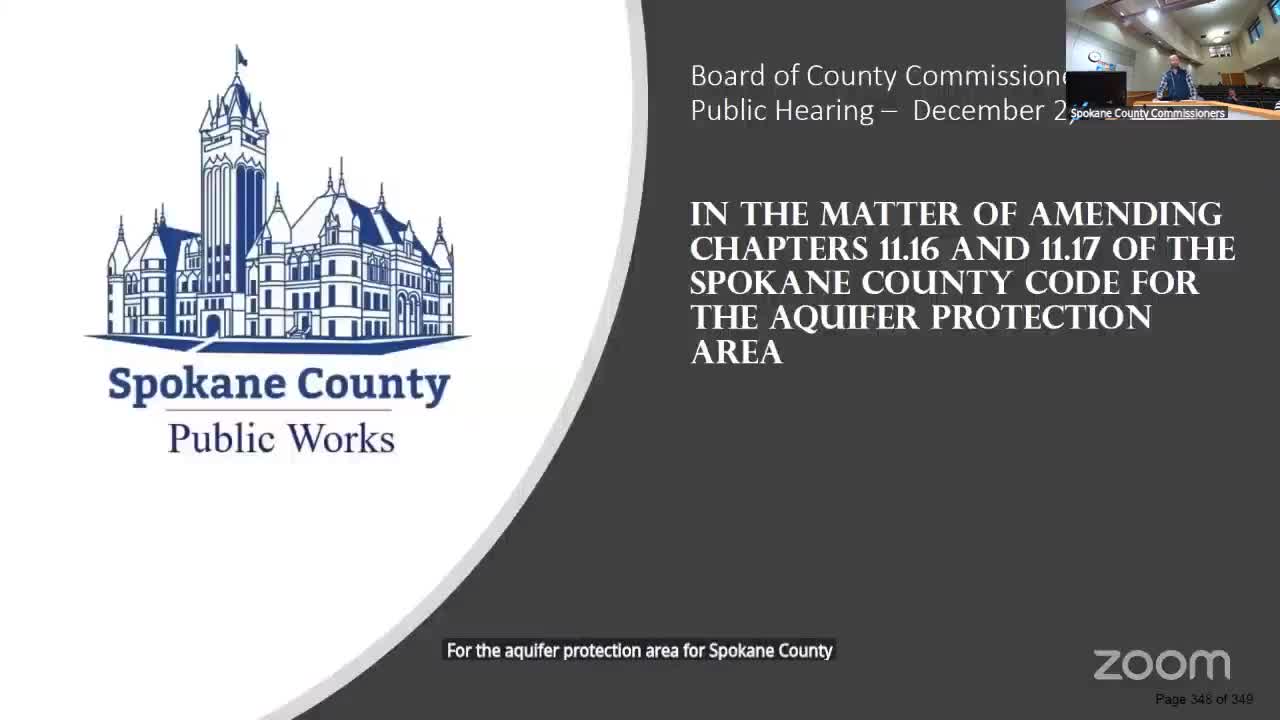
Summary
County staff won unanimous approval to amend Spokane County code to permit another 20-year period of aquifer-protection fee collection for the Spokane Valley–Rathburn Prairie Aquifer. West Plains residents pressed commissioners to declare a PFAS public-health emergency and to press the airport for remediation funding.
Ben Bridal, a county public-works representative, told the Spokane County Board of Commissioners that code changes to chapters 11.16 and 11.17 are administrative and would allow the county to collect the Aquifer Protection Area (APA) fee for an additional 20 years—the third such period and extending the fee-authority to 60 years in total. Bridal said there were no changes to the fee structure and framed the amendment as ensuring the county’s code matches voter-approved APA boundaries.
The board held public testimony during the hearing. Julia McHugh, a West Plains resident who said she lives on a contaminated well, criticized the decision to exclude much of the West Plains from the APA renewal and urged the county to push the airport to contribute to filtration systems. “The airport is responsible for funding the filtration for the contamination that they have introduced on the West Plains,” McHugh said, adding that she has long pushed for a public-health emergency declaration and has seen neighbors suffer serious illnesses she attributes to contamination.
Earlier in the public-comment period, local residents and PFAS task-force supporters urged additional county actions. John Hancock praised the county’s recent steps toward PFAS filtration but proposed five supplemental actions, beginning with asking the local health officer to declare a PFAS public-health emergency and including directed outreach and funding-seeking for testing and remediation. Laura Ackerman, another West Plains resident, told commissioners that a public-health emergency would help households on private wells access needed testing and services.
Commissioners asked staff to describe jurisdictions included in the APA renewal; Bridal confirmed the renewal covers the full boundaries of the cities of Spokane, Spokane Valley, Millwood and Liberty Lake as well as certain unincorporated county precincts. Commissioners also discussed the possibility of pursuing a separate West Plains APA in coordination with municipalities; Bridal said outreach to Airway Heights, Medical Lake and Cheney is underway and that a vote could be considered in 2026.
After discussion, the board moved to accept staff’s recommendation to amend county code to extend the APA fee-collection period; the motion passed unanimously. The amendment is administrative—Bridal said it does not change the fee amounts—and is intended to preserve the county’s ability to collect funds that support aquifer protection programs. The county did not adopt a formal public-health emergency during this session; residents and several speakers urged additional steps to accelerate PFAS testing, filtration purchases and intergovernmental engagement.
The board scheduled an executive session on potential litigation after the meeting and then adjourned for the day.