Get Full Government Meeting Transcripts, Videos, & Alerts Forever!
Get email alerts on the Solar Development topic
No spam. Unsubscribe anytime.
Residents tell Marathon County committee planned 1,000‑acre solar arrays threaten farmland and local businesses
Summary
Public commenters at the Dec. 2 Environmental Resources Committee meeting urged supervisors to use zoning and planning to protect farmland and agritourism from proposed 1,000‑acre solar projects, citing loss of views, long-term contracts and public-safety concerns over battery storage.
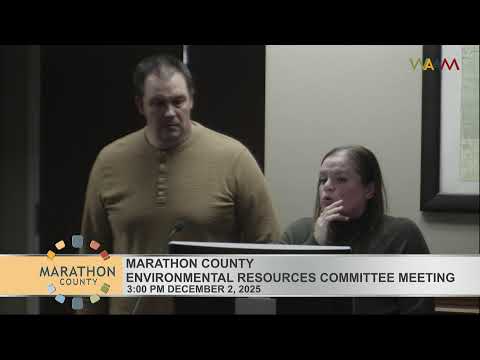
Several residents addressed the Marathon County Environmental Resources Committee on Dec. 2 to warn that large solar developments proposed near small communities would affect farmland, views and local businesses.
Dean Beck, Towne Easton chairman, said he was surprised by elements of the draft manure-management ordinance but also raised alarm over “a potential of a large solar array” planned near his town and said his community had received little county support. He asked whether local residents would have any control over siting decisions and who would pay for fire protection or cleanup for battery storage.
Becky Tetro, who runs the Tansy Hill Farm wedding venue in the Town of Easton, said the adjoining parcel to her venue has been signed with a solar developer and warned that panels could be as close as 30 yards to her property. “The adjoining property to where my brides get married... will be 30 yards from [a] solar farm,” Tetro said, adding that a long contract term could “put me out of business.”
Tetro also asked the county to use planning and zoning authorities to protect farmland and agritourism, saying farmland is “sacred” and expressing frustration that she feels local residents have little say in decisions she described as driven by state-level siting processes.
What the committee did: County staff acknowledged the public comments but noted that large-scale grid decisions involve the Public Service Commission and state-level processes; county zoning tools remain a local avenue for some protections. No formal action on solar siting was taken at the Dec. 2 committee meeting.
Next steps: Concerned residents may follow up with county planning staff, and supervisors indicated they would take public comments into account in related zoning and ordinance discussions.