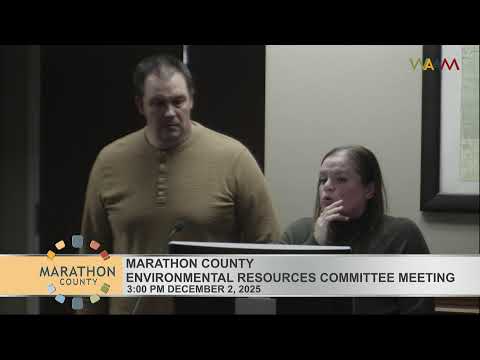
Marathon County panel pauses vote on animal-waste ordinance after state legal questions about buffer cost-share
Loading...
Summary
Marathon County conservation staff asked the Environmental Resources Committee to delay voting on a proposed animal-waste and cropland management ordinance after learning a state agency’s legal counsel may require cost share for proposed buffers; staff outlined nutrient-management training, incentives and a possible winter‑spreading license.
Marathon County conservation staff told the Environmental Resources Committee on Dec. 2 that they recommend delaying a final vote on draft animal-waste and cropland-management ordinance amendments until county attorneys and state agencies clarify whether proposed buffers will trigger mandatory cost share.
Christy Heidenreich, county conservationist, said staff learned “from DATCP just this morning” that the buffer language in the draft could obligate the county to offer cost-share to landowners required to install a 35‑foot buffer along streams. She told the committee that the requirement as written would effectively apply to everyone with a stream on their property and that state legal counsel is still reviewing whether there is a pathway to avoid universal cost‑share obligations.
“...we actually would have to offer cost share to folks that we are asking to put those buffers in,” Heidenreich said, describing the new information from the Department of Agriculture, Trade and Consumer Protection (DATCP) as a surprise and recommending the committee pause action until the county receives written guidance.
Why it matters: The buffer requirement is one of three central elements staff and a farmer work group identified as part of a broader compromise to reduce phosphorus runoff into local streams and meet state water-quality expectations. If buffers must be cost-shared for every affected parcel, staff warned, the county could face substantial fiscal and logistical challenges to implement the measure in a timely way.
Staff emphasized that the ordinance is built on a large evidence package: Heidenreich said the county’s “white paper” and supporting materials — made publicly available on the county’s CPZ website — include scientific data and analysis used to justify the proposal and that state agencies (DNR and DATCP) require evidence before they will approve such an ordinance.
Training, incentives and alternatives: Conservation analyst Matt Repking walked the committee through the county’s nutrient-management training and incentive program that staff argue will lower the practical burden on farmers. He described the course and reimbursement structure: the upfront cost to create a new nutrient-management plan is $260, and “with the incentives through the class, the person is reimbursed $600,” effectively producing a net incentive. Staff also said the county offers cost share of $40 per acre to start a new plan and a soil‑sampling incentive of $9 per sample up to $750.
Staff framed the winter‑spreading license narrowly: it would target liquid (pumpable) manure on frozen soils and would not apply to small farms under the threshold for restrictions (farms under 300 animal units). Heidenreich said the license could be priced on an acreage basis and that staff plan to use SnapPlus mapping to identify fields where winter spreading is scientifically safe.
Committee direction and next steps: Given the DATCP legal-review item, staff asked the committee to “hit the pause button” and return in January with documentation from state counsel and options for how the county might proceed. Multiple supervisors said they were comfortable delaying the vote to obtain the state’s written view. Staff repeated that statutory review timelines (including a 90‑day review by DNR and DATCP and possible Land and Water Conservation Board review) remain part of the overall schedule.
The committee did not take a final vote on the ordinance at the Dec. 2 meeting. Staff will report back after receiving the state legal opinion and may present revised ordinance language or implementation options at the January meeting.