
Wyoming judiciary warns JSA fund will run out; seeks $20 filing fee increase and staff realignment to stabilize tech account
Get AI-powered insights, summaries, and transcripts
Subscribe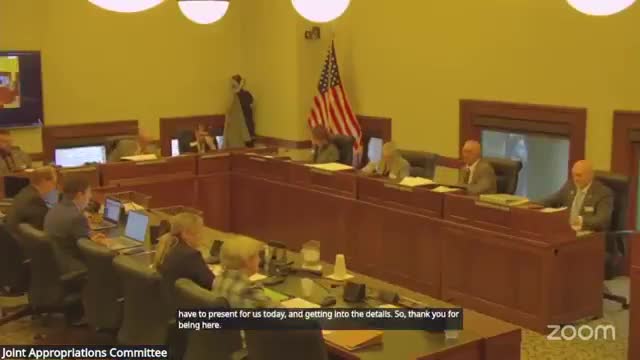
Summary
Chief Justice Lynn Boom Guard told the Joint Appropriations Committee the Judicial Systems Automation (JSA) account is at risk of insolvency by fiscal 2029 and proposed moving 13 IT positions to the general fund and a bill draft to raise filing fees by $20 to bolster the account.
Chief Justice Lynn Boom Guard told the Joint Appropriations Committee that the Judicial Systems Automation (JSA) fund, which pays for court software and courtroom technology, faces depletion without immediate changes.
"Our general fund exception request for biannual fiscal years 2026 to 2028 are modest, approximately 5 and a half million dollars," Boom Guard said, stressing that most requests reflect technology needs rather than wants. She and state court administrators told lawmakers the JSA account, funded primarily by filing fees, has been used to pay personnel and infrastructure costs beyond its original statutory purpose and is projected to be insolvent by fiscal year 2029.
The judicial branch laid out a two‑part proposal to extend the fund's life. Administrators asked the committee to approve moving the appellate court docket management subscription (Ctrack enterprise) into the JSA account, and to transfer 13 information‑technology positions currently paid from JSA into the general fund. "That increase would be more than offset if we can move the 13 FTAs that are IT positions that are currently funded by the JSA account into the general fund," Boom Guard said.
To improve revenues, the branch presented a bill draft to raise the filing fee that supports JSA by $20. Chief fiscal officer Claire Smith told the committee that every $5 increase in the filing fee is estimated to produce about $900,000 in revenue; she said a $20 increase would generate "something short of $4,000,000." Smith also described the account's history: established in 2000 as a special revenue fund for court automation, it has become a "spillover account" paying personnel and other costs.
Lawmakers pressed administrators on contingencies if a fee increase fails. Administrators said they would continue to "belt tighten," prioritize expenditures and return with supplemental requests if necessary, but warned that continued delays will force reductions in technology and potentially curtail remote public access and court functions. The committee heard examples of equipment failures — including aging Surface Hubs — that temporarily removed remote appearance and streaming safeguards and underscored the branch's argument that continued investment is needed to protect access and security.
Why this matters: The JSA account supports critical court functions — cloud services, cybersecurity, e‑filing and courtroom AV — that the judiciary says are necessary for statewide access, efficient dockets and victim protections. Lawmakers requested additional documentation, revenue projections and history of JSA use as they weigh the proposed staff realignment and fee increase.
Next steps: The committee did not take a formal vote during the hearing. Officials said the fee increase is the subject of a bill draft and that the branch may return in a supplemental if the legislature does not act.