
San José approves $1B-range prepay green bond to secure long-term clean energy supply
Get AI-powered insights, summaries, and transcripts
Subscribe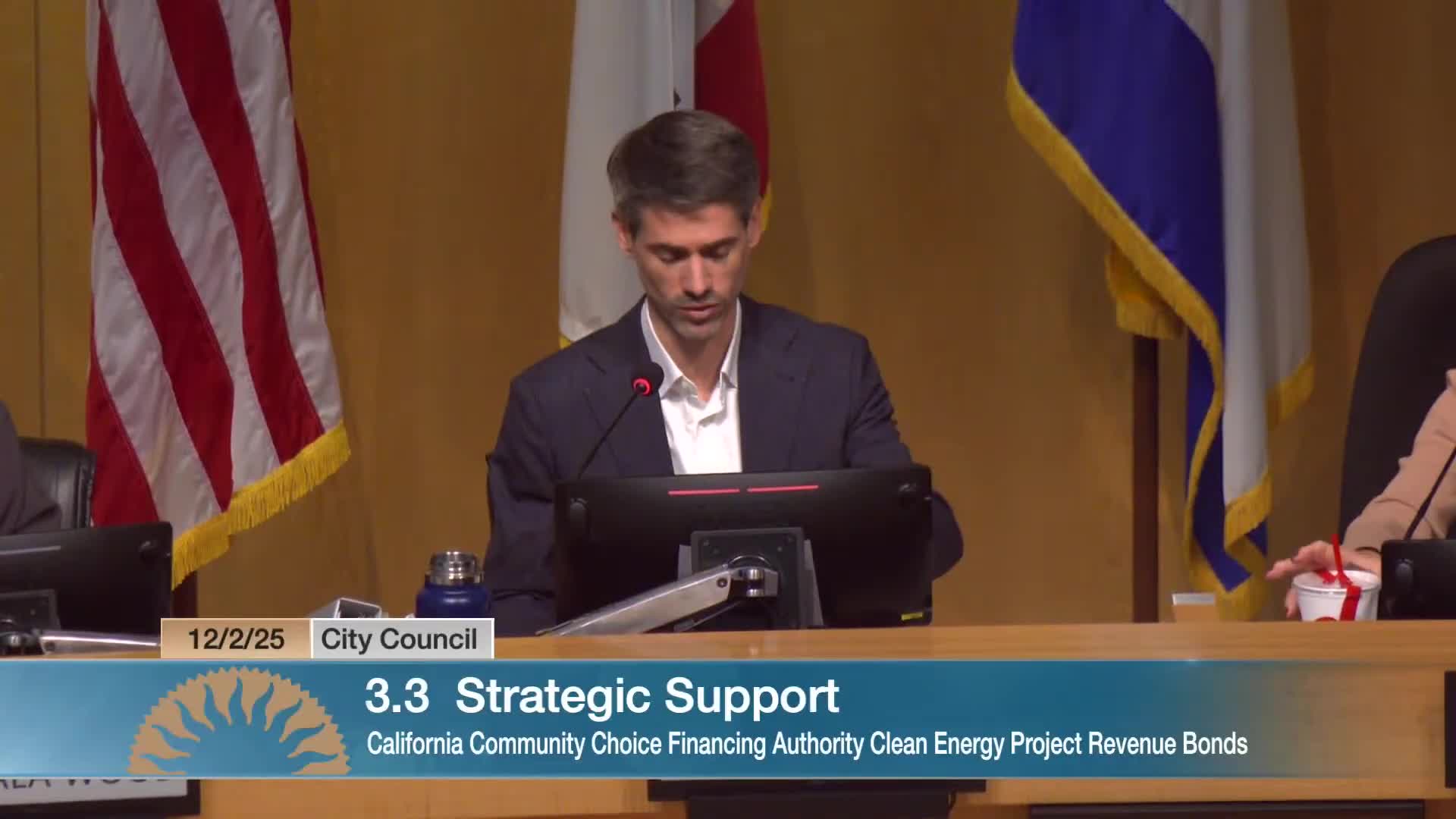
Summary
City council approved a complex 30-year prepay financing transaction in which a financing authority issues tax-exempt green bonds to procure pre-paid renewable energy from Morgan Stanley; staff highlighted expected savings, market and counterparty risks, and mitigation steps.
The San José City Council on Dec. 2 approved staff'recommended documents for a 30-year prepay renewable-energy financing transaction that uses a community-choice financing authority structure and a Morgan Stanley-prepaid supply arrangement, city finance staff said.
City staff described the deal as a variation of a prepay structure: the financing authority would issue tax-exempt green revenue bonds (staff estimated more than $1 billion in bond proceeds as a working figure) to purchase a 30-year stream of energy assigned by the city's existing power purchase agreements. The bonds would be non-recourse to the city; XFA (the issuer described in the presentation) would market the bonds and sell the energy back to the city at a discount. Staff said the city requires a minimum annual savings target (8% during the initial term) and that the financing includes standard market risks, a volumetric risk if suppliers fail to deliver, and counterparty risks mitigated by multiple swap counterparties and backup obligations from Morgan Stanley.
"These agreements are ones we've already approved as PPAs," the deputy director of energy said in the presentation, noting that staff would assign only part of current PPA rights to the transaction and preserve diversification in the overall city portfolio. The staff estimate dated Oct. 28 showed a probable bond issuance size in the $1 billion range with a true interest cost a little over 4% on that day. Staff also reported reserving approximately $41 million of proceeds for capitalized interest and roughly $6.2 million for financing costs.
Council members pressed staff on downside scenarios, including what happens if market prices fall after the city locks in this prepay structure. Staff answered that the city would manage price risk through a diversified portfolio, retain a portion of its PPA rights outside the transaction and rely on bond termination provisions and issuer obligations if counterparties default; if the transaction terminates the PPAs would revert to the city.
After questions, Councilmember Keimei (as recorded in the transcript) moved to approve the staff recommendations. The motion passed unanimously.
The city said the bonds are expected to be marketed later this month or in January depending on market conditions; staff said they would also seek approval from the financing authority board and proceed to pricing and closing when market conditions permit.
Next steps: staff will seek the financing authority board's approval, monitor market conditions to set pricing and close the bonds, and return with final transaction documents and official pricing information.