
Columbia County planning manager explains zoning, public hearings and how residents can engage
Get AI-powered insights, summaries, and transcripts
Subscribe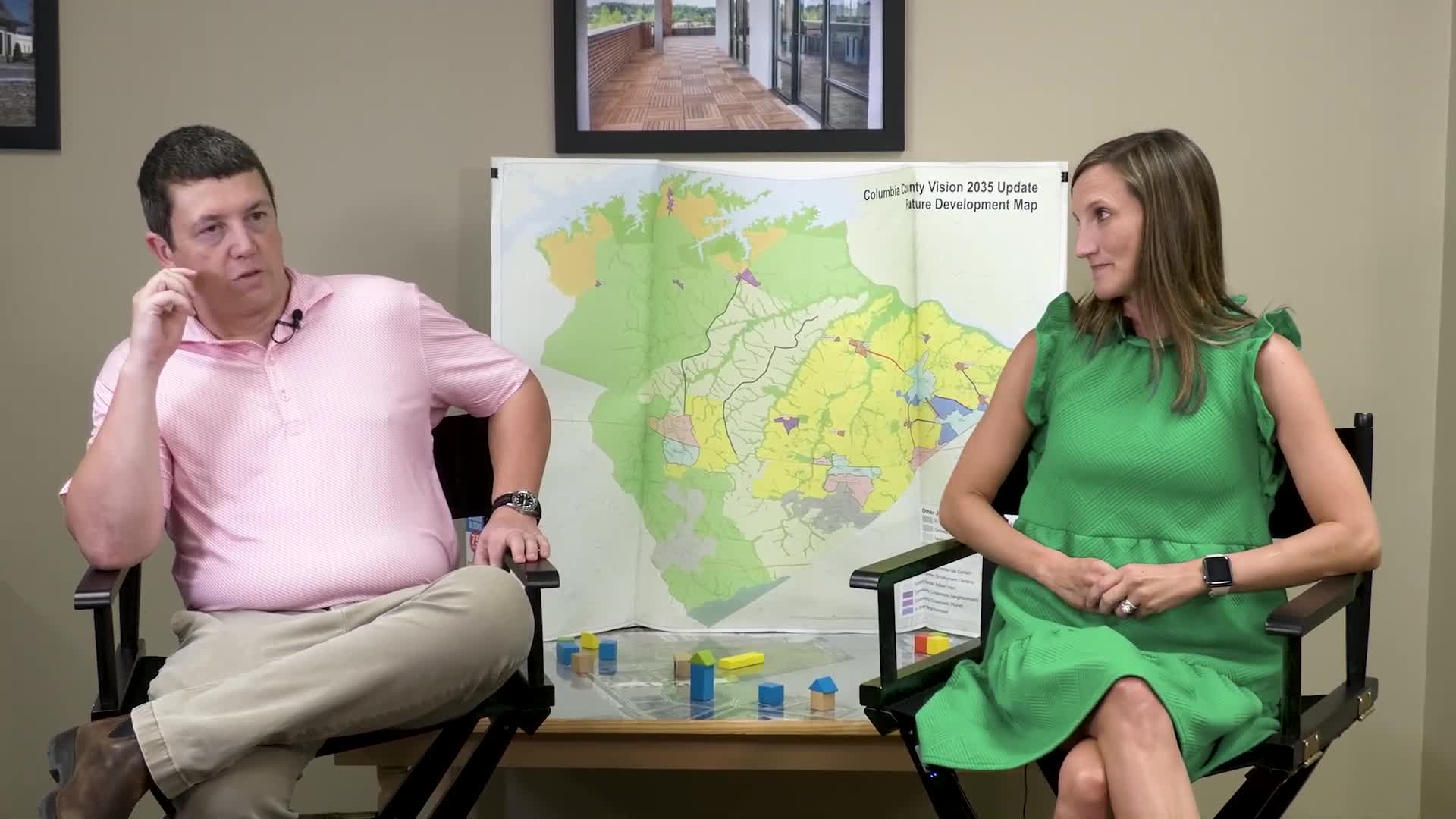
Summary
Planning manager Will Butler outlines the department's role advising developers, coordinating reviews across county departments, and the public hearing process, including notice rules and how residents can view applications and submit comments.
Cassidy Harris, Columbia County's public relations director, opened a county "A to Z" episode by introducing Will Butler, the planning manager, to explain what the planning department does and how residents can follow local land-use decisions.
"So planning is basically the built environment," Butler said, describing planning as the set of rules and processes that determine what can be placed on a piece of property and how the community grows. He said the department helps applicants determine whether a site and its zoning are compatible with their proposed use and then guides them through rezoning, site-plan and building-plan steps.
Butler emphasized staff serve throughout a project's lifecycle, from early rezoning conversations through final landscape review. "We're gonna be there from when you start your project," he said, adding that staff coordinate reviews by roughly a dozen departments so applications are evaluated holistically.
On public input, Butler said hearings are "basically required by law" and exist to notify neighbors and allow comment. He listed typical hearings (rezonings, variances, conditional-use permits and design variations) and explained notice timing: the property sign is posted 15 days before a hearing, and a recent state-law change now requires about 30 days' notice in the newspaper for some cases; Butler did not cite a specific statute.
Residents can review applicant materials on the county's public-hearings map, Butler said, and may email or call staff to have comments included in the planning-commission packet. The department also offers monthly educational sessions—"zoning 101, 201"—to explain rezoning, the comprehensive plan and commercial development.
Harris noted the county is updating its comprehensive plan, "Foundations for the Future." Butler said the plan is in draft form and that staff are incorporating community survey comments before releasing materials for public review.
Butler clarified the planning department does not select businesses for locations. "We're not the ones going in there and handpicking," he said, explaining brokers and developers typically seek tenants; zoning merely sets which uses a parcel can accommodate. He used Mullins Colony's C2 zoning as an example of a district that allows multiple commercial uses.
The planning team, Butler said, is made up of four staffers (Planner I, Planner II, community planner and planning manager) who handle both commercial and residential reviews, sign permits and advise prospective applicants. He described the process of recommendations: staff provide professional recommendations to the Planning Commission, which holds the public hearing and then forwards a recommendation to the Board of Commissioners; the board makes the final decision.
Harris closed by encouraging listeners to visit the county website for the public-hearings map and event calendar and to contact the planning department with questions.