
State Water Board adopts clarified diversion measurement rules, delays some implementation to 2026–27
Get AI-powered insights, summaries, and transcripts
Subscribe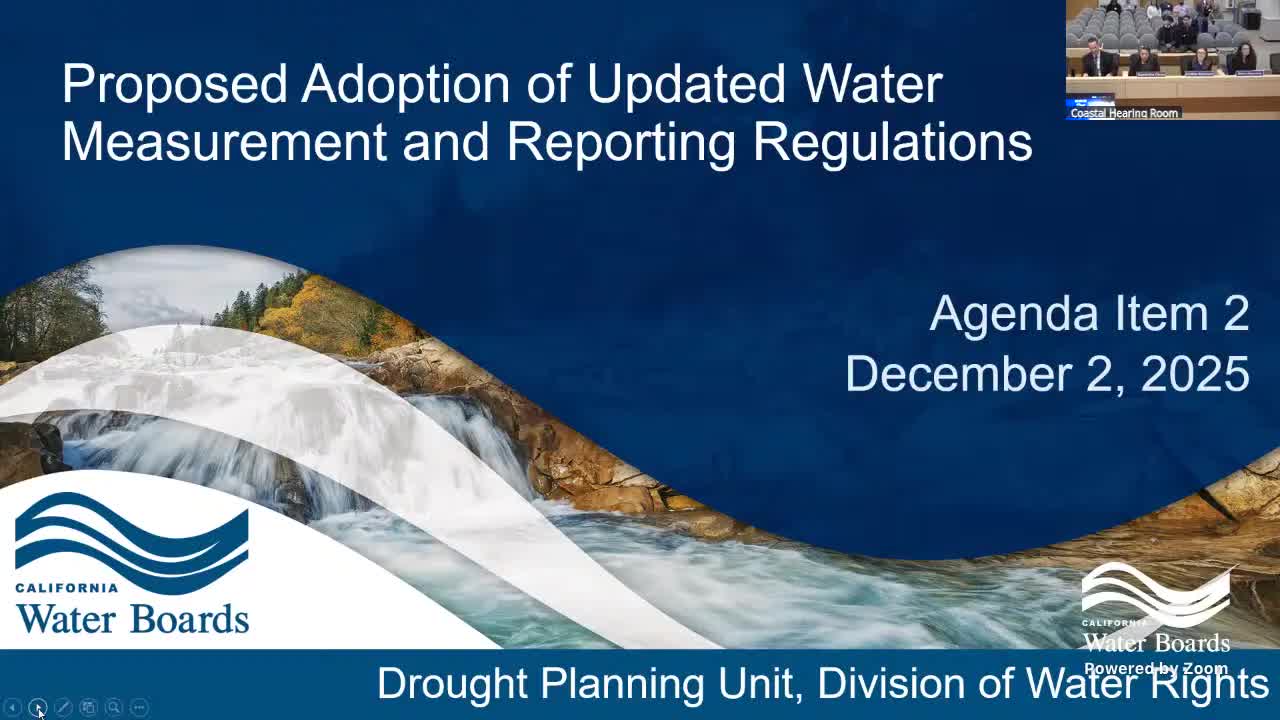
Summary
The State Water Resources Control Board adopted revised diversion measurement and reporting regulations (chapter 2.8, “SB 88” updates) on Dec. 2, 2025, after Office of Administrative Law feedback prompted clarifying edits. Most substantive measurement changes take effect Oct. 2026 with phased implementation through Jan. 2028.
The State Water Resources Control Board on Dec. 2 adopted clarifying revisions to California’s diversion measurement and reporting regulations (commonly discussed under SB 88), after staff withdrew and revised chapter 2.8 following feedback from the Office of Administrative Law.
Board staff said the changes mostly clarify language and procedures — for example, how deputy directors approve alternate websites for posting large‑diversion data and how notice and public comment would occur for threshold adjustments. Staff and presenters Lindsay Kamire and Sierra Kennison said the edits do not create new substantive obligations; rather, they fix potential points of confusion flagged by OAL so the rules meet Administrative Procedure Act clarity standards.
The board approved a phased schedule. Staff said the updated measurement requirements specifying which parameters to collect will take effect Oct. 2026 (start of water year 2027); annual reports reflecting the new format will be due in Jan. 2028. Large‑diversion posting requirements will phase in by Oct. 2027, and diverters must register measuring devices and submit documentation beginning Jan. 2027. Staff emphasized outreach, guidance materials, one‑on‑one assistance and the ability for diverters to request an alternative compliance plan.
Public commenters included attorneys from BKS Law, who urged clearer wording in section 9.35 (arguing the verb “leaves” is ambiguous) and questioned new interim enforcement language in section 9.39. Staff responded that the context of the sentences narrows the meaning of “leaves” to outflow measurement locations and defended provisions that require newly installed devices to meet updated technical standards to avoid confusion later.
Board members asked how the weekly, high‑level reporting will treat flood‑control or recharge releases. Staff said the weekly large‑diversion metric is intended as a mass balance reporting of all water leaving a reservoir and is not intended to apportion flows to specific claimed water rights on a weekly basis; more precise allocation is difficult in near‑real time and can be pursued through alternative compliance plans.
The board moved and approved the resolution by roll‑call vote. Staff will submit the final rulemaking package to the Office of Administrative Law and continue outreach to help diverters comply.
The board’s action preserves the staggered schedule for implementation and commits staff to additional guidance and support for water‑right holders during the transition.