
Council committee upholds Planning Commission on Sheridan condos appeal, adds landscaping condition
Get AI-powered insights, summaries, and transcripts
Subscribe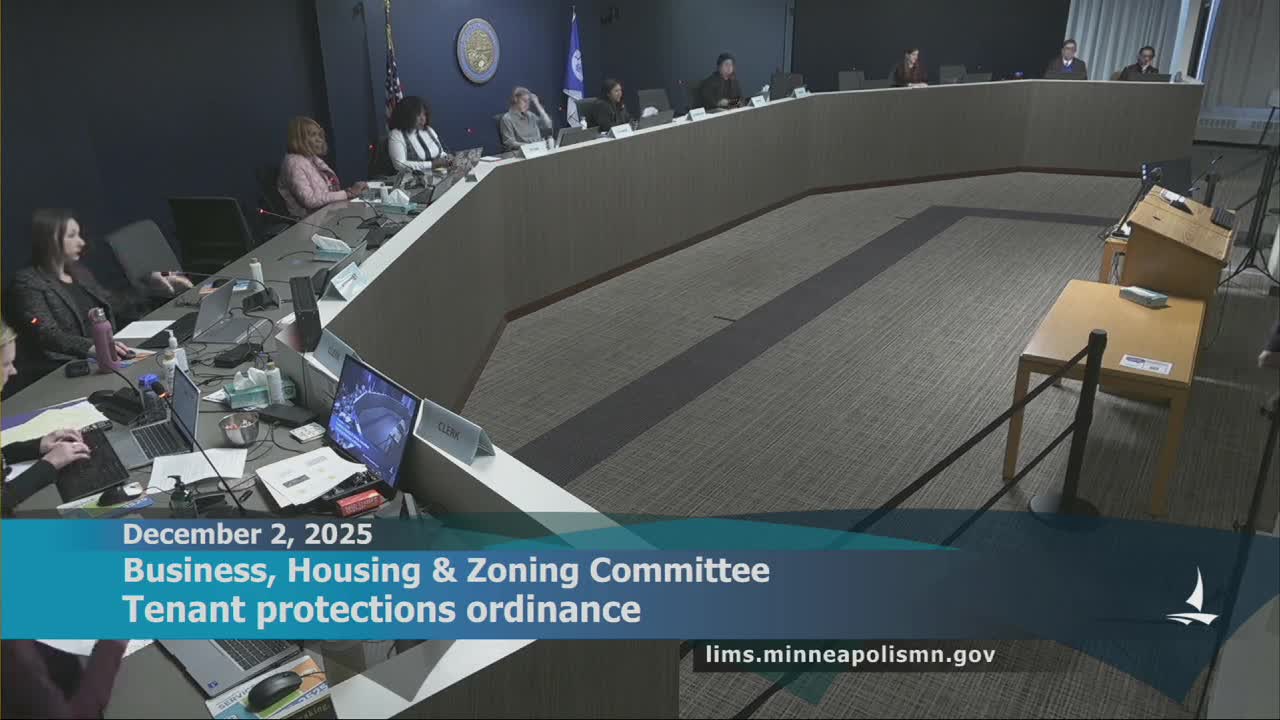
Summary
After contested public testimony on shadowing, foundations and the claimed environmental premium, the committee denied an appeal of approvals for a four‑story condo at 4109–4113 Sheridan Ave S, adopted staff findings and added a condition requiring enhanced rear‑yard landscaping to mitigate impacts on adjacent properties.
The Business, Housing and Zoning Committee on Dec. 2 denied an appeal of approvals for a proposed four‑story residential project at 4109 and 4113 Sheridan Ave S and adopted city staff and Planning Commission findings, while adding a condition requiring the developer to enhance rear‑yard landscaping.
CPED planner Lindsay Silas summarized the approvals under appeal: a conditional use permit to increase the rear height in the Shoreland Overlay District from 2½ to 3 stories, an administrative height increase at the front from 3 to 4 stories tied to an environmental sustainability premium, and site plan review. Staff concluded the project met code standards and that additional setbacks and stepbacks mitigated shadows and bulk.
Tom Devink, attorney for the Linden Hills Community Coalition and the appellant, said the administrative height increase "adds an entire floor" and objects to treating the climate‑resiliency premium as satisfied without detailed, verifiable plans. He said some neighbors’ rooftop solar arrays would be rendered ineffective and that the plan lacked the documentation necessary to earn the premium on its face.
Applicant Josh Siegel of JLS Design Build argued staff and the Planning Commission correctly applied ordinances and submitted shadow studies showing only minimal incremental shadowing compared with by‑right massing. "We complied with the premium's environmental requirements," he said, adding the firm expects to achieve much of the renewable energy from rooftop solar on day one.
Neighbors who testified opposed the approvals, citing scale, shadowing of solar panels, potential drainage and construction impacts from deep excavation for an underground garage, and loss of naturally occurring affordable units. One neighbor, Steve Higgins Whiteside, said the proposal would block his solar panels and impose a financial cost. Supporters and Planning Commission members urged denial of the appeal, noting the site sits on a Corridor 3 zoning designation and is planned for increased residential intensity.
Council Member Palmisano, whose ward includes the site, proposed — and the committee accepted as a friendly amendment — a condition that the applicant work with staff to provide enhanced rear‑yard landscaping (trees, shrubs or plantings) in the south interior yard to address privacy and the CUP finding that the use not be injurious to neighboring properties.
The committee voted to deny the appeal, adopt staff findings, and add the landscaping condition.
Why it matters: The decision affirms staff and Planning Commission discretion to grant height premiums tied to sustainability commitments and emphasizes that administrative premiums are verified at the building permit stage; it also highlights neighbor concerns about solar access, stormwater, and construction impacts.
What’s next: The applicant must show compliance with the sustainability premium at permitting and implement the agreed landscaping per the committee condition before permits progress.
Quoted sources in this article are drawn from committee testimony and staff presentations.