
Minneapolis committee stalls Tenant Opportunity to Purchase ordinance after hours of testimony
Get AI-powered insights, summaries, and transcripts
Subscribe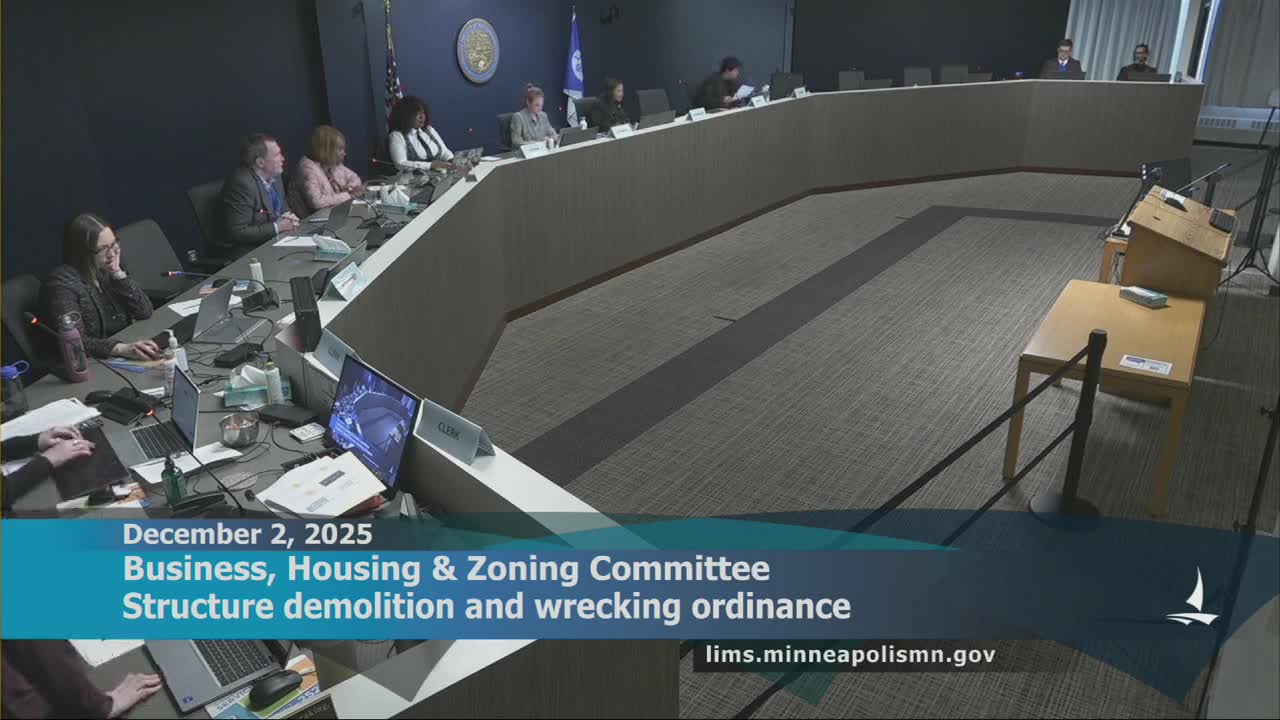
Summary
After hours of public testimony both for and against, authors asked the Business, Housing and Zoning Committee to take no action this term on a proposed Tenant Opportunity to Purchase ordinance; the committee left the measure in committee following a failed motion to return it to authorship. Advocates said it could curb displacement; real‑estate groups warned it would delay sales and constrain financing.
Vice Chair Oreen Chowdhury opened a lengthy Dec. 2 public hearing on a proposed Tenant Opportunity to Purchase (TOPA) ordinance, but the co‑authors requested no vote this term and asked the council to leave the measure in committee.
"Tenant opportunity to purchase offers [renters] a meaningful chance to stay in their homes, build collective power, and in some cases, take steps towards ownership," Chowdhury said, summarizing the authors’ view and explaining why the ordinance would be held in committee rather than advanced to a full council vote this term.
The hearing drew more than a dozen speakers representing tenants, housing advocates and the real‑estate industry. Speakers for the ordinance said TOPA could preserve homes and curb displacement. "TOPA policies have a proven track record of success," Jessica Shyminski, a policy attorney with the Housing Justice Center, told the committee, citing Washington, D.C. data referenced in her testimony.
Housing advocates emphasized implementation supports. "TOPA policies are most impactful when paired with robust supports for tenants," Shyminski said, urging the council to add funding for tenant organizing, legal assistance and acquisition financing.
Speakers opposing the draft said the proposal would impose lengthy, stacked timelines that jeopardize ordinary real‑estate transactions and increase costs for sellers and buyers. Miles Artis, director of government affairs for Minneapolis Area Realtors, said the greatest obstacle for tenants is qualifying for mortgages, not the right to purchase. "Most tenants, once they qualify to buy, choose to buy another more permanent home on the open market," he said.
Several small owners and property managers warned the ordinance’s timelines and buyout provisions would delay closings and discourage investment. "The sale process will easily be delayed by 6 to 12 months," said Stacy Meyier of Bader Management, adding such delays make it hard to align financing or close exchanges.
Elected members expressed mixed views. Council Member Robert Chavez said he supports moving forward with a stronger version of the ordinance in a future term: "It is meant to be an anti‑displacement policy," he said, describing neighborhood efforts that stepped in when residents faced displacement.
Council Member Vita moved to return the ordinance to the authors for further work. The motion was called and, in a roll call, recorded 2 ayes and 3 nays; it failed. With no further motion to forward the ordinance, the committee left the measure in committee and will not send it to the full council this term.
Why it matters: Authors and advocates said TOPA is intended to provide renters with a direct path to ownership and help stabilize communities. Opponents argued it would create administrative burdens, lengthen sales timelines and shift costs onto sellers, potentially reducing housing investment.
What’s next: The ordinance will remain in the Business, Housing and Zoning Committee through the end of the current term; authors signaled an intention to continue stakeholder engagement and refine the draft for consideration in a future term.
Speakers quoted in this article appear in the committee record.