
State Water Board adopts revised diversion measurement rules, delays some requirements to next water year
Get AI-powered insights, summaries, and transcripts
Subscribe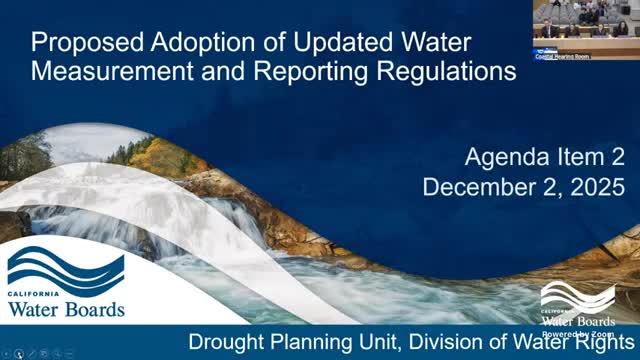
Summary
The State Water Resources Control Board voted unanimously Dec. 2 to adopt revised measurement and reporting regulations (Chapter 2.8, linked to SB 88) after OAL-flagged clarifications. Staff said the updates improve data quality and clarity; several implementation dates are pushed back to allow outreach and phased compliance.
The State Water Resources Control Board on Dec. 2 approved revisions to diversion measurement and reporting rules aimed at improving data quality and machine-readability and clarifying when and how diverters must report large-diversion data.
"We're asking you to adopt the draft resolution that has been circulated, which approves the proposed regulation text and allows staff to submit the final rulemaking package to the Office of Administrative Law," said Lindsey Kamire of the Division of Water Rights during staff's presentation.
Staff told the board that Office of Administrative Law reviewers flagged clarity issues in Chapter 2.8, including the potential for threshold adjustments to be misread as applying statewide and language describing deputy director approvals. Sierra Kennison, a water resource control engineer, said the revised text "does not result in any new requirements or burden on the diverters" and that changes mostly address how notices will be issued and how deputy director approvals will operate.
One subject of public comment was the wording in Section 9.35 that uses the verb "leaves" to describe water exiting a reservoir. Zach Hasdonguell Johnson, an attorney with BKS Law, said that phrasing could create ambiguity about whether evaporation or emergency flood releases must be reported. Johnson urged staff to clarify and requested a compliance checklist for water year 2026. Staff responded the weekly submissions are intended to capture the total outflow from a reservoir rather than apportionment by water right and that guidance and one-on-one assistance will be made available.
Because of the textual changes, staff said the effective dates for updated measurement requirements will be pushed back so diverters have more time to adjust. Kennison outlined a phased schedule: updated measurement requirements taking effect in October 2026 (water year 2027) and certain submission requirements phased in by October 2027; the first annual report using the updated format will be due in January 2028.
After board discussion and staff responses to commenters, the board moved, seconded and adopted the resolution unanimously. Board members said the delay will facilitate outreach and compliance while improving long-term data utility.
The board directed staff to submit the rulemaking package to OAL and to continue outreach, guidance materials and one-on-one compliance assistance.
The action was taken during the board's Dec. 2 hybrid meeting in Sacramento.