Get Full Government Meeting Transcripts, Videos, & Alerts Forever!
Get email alerts on the Transportation Budget topic
No spam. Unsubscribe anytime.
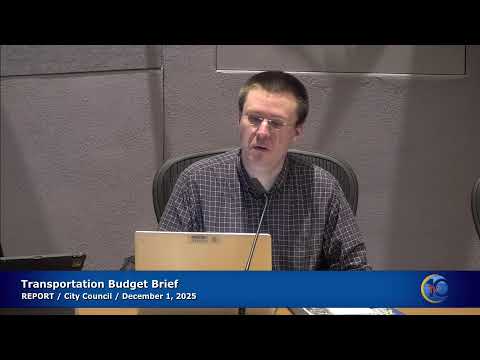
Charlottesville outlines four-year transit staffing plan, flags capital cost pressures
Summary
City Manager Sam Sanders presented a transportation-focused FY27 budget brief proposing phased hiring to grow from 66 operators toward a 108-operator target, tied to service-frequency gains and significant capital and ADA needs; staff also reported cost overruns on Meadow Creek Trail and temporary delays to several projects.
City Manager Sam Sanders on Monday told the Charlottesville City Council that the city intends to phase a major expansion of transit operators over the next four years, aiming ultimately for 108 drivers to enable more frequent service and, eventually, Sunday service.
"We've identified that a 108 operators is the target that we're trying to achieve," Sanders said, describing a four-year phase-in tied to revenue performance and budget capacity.
Why it matters: Transit-dependent riders and neighborhoods targeted for frequency improvements would see the biggest changes if the city can hire operators and absorb the recurring payroll costs. Sanders said a near-term step would be to add about 10–11 operators next year to move from the current 66 operators to about 76, which would introduce more 15-minute frequencies on certain high-demand routes.
The trade-offs: Garland, director of transit, told the council that driver payroll to reach the 108-operator scenario would add roughly $3.3–$3.4 million in recurring personnel costs based on current wages. He and other staff warned that collective-bargaining increases and other operating expenses would raise that baseline.
"Just for the drivers, that is 3.3 almost $3,400,000 just for the drivers based on today's cost," Garland said.
Staff stressed hiring capacity and vehicle availability as constraints. Garland said the city has vehicle capacity until it reaches about 90–95 drivers and estimated the training capacity for new operators at roughly 15–16 trainees at a time, making steady, phased hiring more feasible than a single large recruitment push.
Funding and grants: Councilors and staff discussed uncertainty in state operating-assistance funding and possible changes under a new administration. Garland said some state proposals previously threatened cuts in the $600,000–$1,000,000 range but expressed guarded optimism that new state-level leadership could change funding prospects; the question remains unresolved as the General Assembly session approaches.
Capital, infrastructure and safety priorities: Sanders reviewed recent and planned capital work—completed bus shelters, sidewalk projects (Prospect Avenue; 9th Street at Forest Hills), a completed Rugby Avenue shared-use path, and an upcoming Washington Park connector—and described an "urgent infrastructure" list created after an October 2024 pedestrian fatality on Elliott Avenue. He said the city identified 34 urgent projects and made $500,000 available to address them quickly.
Sanders also highlighted the ADA transition plan and the city's five-year CIP allocation: council previously set aside $2 million annually toward ADA-related projects, but Sanders said the transition plan identified roughly $150 million in citywide improvements needed to comply fully and that current funding is a down payment.
Project challenges: Several capital projects are over budget or delayed. Sanders cited Meadow Creek Trail and Pollock's Branch Bridge as examples. He said Meadow Creek has grown from an earlier hoped-for cost of about $500,000 to multi‑million dollar estimates and that the administration expects to return in January with a clearer supplemental request (Sanders referenced a ballpark of $600,000–$700,000 more but said the figure is not yet finalized). He also said Pollock's Branch requires resurveying and redesign because of scope changes tied to South First Street construction.
EV buses and grants: Staff said the city has electric buses on order (two expected in May 2026) but that federal low/no-emissions grant rounds are largely exhausted; the city’s recent application was not successful and some federal programs may pause for several years. Staff warned that maintenance facility upgrades needed for battery-electric buses are expensive and will require additional capital work.
Operations and amenities: Councilors pressed staff on bus-shelter timelines and quick-build treatments. Garland explained that site planning, VDOT approvals, and community vetting can delay shelter installation (site plan reviews can take four to six months, and winter construction windows constrain timing). Ben Chambers, transportation planning manager, said quick-build pilots produce mixed feedback and staff are using speed/volume data to measure impacts; councilors noted plastic bollards sometimes fail in wind and collisions.
Pilot and enforcement programs: The city is piloting photo enforcement in three school zones chosen based on crossing-guard recommendations; staff plan to evaluate pilot results before deciding on expansion. Sanders said the city and Albemarle County have agreed to retain fare-free transit during the upcoming budget year.
Next steps: Sanders said the budget adoption process is scheduled for April 9, and the next budget brief on housing will take place Dec. 15. He urged council to weigh hiring and service choices against competing budget priorities and revenue projections.
Procedural outcome: At the end of the work session the council moved into a closed session to discuss prospective board and commission appointments. The motion to convene closed session pursuant to Virginia code was seconded and approved by voice vote.
What to watch: Council decisions this winter on how many operators to add in FY27 and whether to fund further capital requests for Meadow Creek and other projects will determine how quickly Charlottesville can deliver more frequent and more reliable transit service.