Get Full Government Meeting Transcripts, Videos, & Alerts Forever!
Get email alerts on the Uws Programs topic
No spam. Unsubscribe anytime.
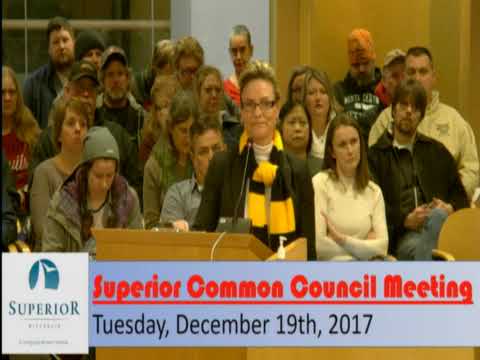
Superior council declines to adopt resolution opposing UWS program suspensions after packed public hearing
Summary
After hours of public comment, the Superior Common Council voted 5–4 and failed to reach the six‑vote threshold needed to adopt a resolution opposing program suspensions at the University of Wisconsin–Superior. Speakers from the university, students, faculty and alumni urged council support but disagreements about the council’s authority divided members.
The Superior Common Council considered and failed to adopt a resolution opposing program suspensions at the University of Wisconsin–Superior after lengthy public comment and council debate. Councilor Riley Van Sickle moved the resolution with a second from Councilor John Ludwig; a roll call vote recorded five yes and four no votes and the motion did not meet the six‑vote requirement to pass.
Chancellor Renee Wachter attended the meeting and told the council the suspensions were a strategic step tied to the university’s metrics and strategic plan, and she said the action did not signal campus closure or a merger. “There is absolutely no talk about campus closures,” Wachter said, and she provided program enrollment figures: at the time of the suspensions there were 85 students enrolled across the affected programs (less than 3 percent of the student body) and roughly 42 students in those programs at graduation.
Faculty, students, alumni and community members filled the public comment period to urge the council to act. John Ludwig, a staff member at UWS, said the decision lacked sufficient involvement of students, staff and faculty and cited shared‑governance provisions he said were not followed. Ben Danberg, vice president of the Student Government Association, told the council that student opinion was mixed but that many students opposed the process and wanted more student‑government engagement. Faculty representatives and local alumni repeatedly warned of long‑term economic and civic consequences if programs that serve regional needs are eliminated.
Opponents on council urged caution and questioned whether the city council had jurisdiction over operational university decisions. Councilor Fennessy said the matter “is not a city council issue” in the sense of direct governance and said the council must be mindful of its scope. Councilor Fennessy and other dissenting members recommended abstention or that the council refrain from passing the resolution because it concerns an operational university decision.
On roll call the motion received yes votes from Councilors Elm, Ludwig, Dalbeck, Van Sickle and Bender; Councilors Sutherland, Kern, Olsen and Sweeney voted no. Because Superior’s rules require six votes for that kind of resolution, the motion failed and the council did not adopt the opposing resolution. No additional council action on the matter was taken that night.