Get Full Government Meeting Transcripts, Videos, & Alerts Forever!
Get email alerts on the Foreign Policy Resolution topic
No spam. Unsubscribe anytime.
Eureka council agrees to return anti-war resolution on Venezuela after public pressure
Summary
After multiple public commenters urged the city to oppose U.S. military action in Venezuela, the Eureka City Council voiced consensus to place a resolution opposing attacks on Venezuela (and support for the War Powers Resolution) on a future agenda.
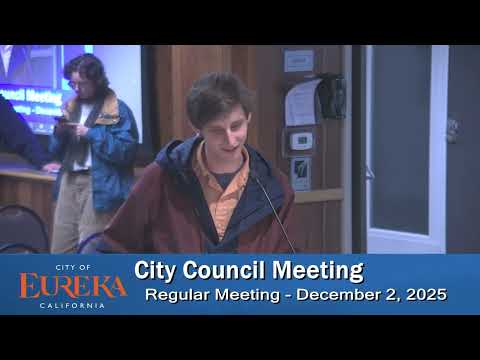
Dozens of public commenters urged the Eureka City Council on Dec. 2 to add a resolution opposing U.S. military action against Venezuela to a future agenda. Speakers representing the Humboldt Antiwar Committee and other groups argued the city should stand in solidarity with Venezuelans and oppose intervention.
David Haney, a former secretary of the Humboldt County Human Rights Commission, told the council the city should "take a stand" and asked the council to place the resolution on the next agenda. Ryan Wilton and other speakers pressed similar points, saying the measure would reflect the community—s values and condemn attacks on civilian boats and U.S. interference.
Councilmember Fernandez moved the item to future agendas during the "future agenda items" portion of the meeting, and council members expressed consensus to return the matter with language that could also reference support for the War Powers Resolution, which would require congressional authorization for military action. City Attorney Black advised that a formal legislative action would need to be agendized but that the council could direct staff, by consensus, to prepare correspondence or a resolution for the next meeting.
There was no formal vote on a substantive resolution during the Dec. 2 meeting; instead the council agreed to bring the proposed resolution back for formal consideration. The council asked staff to prepare contextualizing correspondence and to agendize the resolution so members and the public can debate and, if desired, adopt it at a subsequent meeting.
The next procedural step is the council agenda item: staff will draft the resolution and accompanying correspondence for the council's December meeting cycle so that the item can be formally considered and, if a motion is made, be subject to a recorded vote.