Get Full Government Meeting Transcripts, Videos, & Alerts Forever!
Get email alerts on the Broadband Project Update topic
No spam. Unsubscribe anytime.
Albemarle-area broadband build delayed; authority hears extension request and timeline clarifications
Summary
At a Broadband Authority I meeting, staff said the regional build will likely need an extension to June 2026, reported about 171 miles of fiber installed but not yet tested, and outlined site-siting and funding constraints that could affect final service dates.
At a meeting of Broadband Authority I, staff told members the regional broadband build will likely require an extension to June 2026 and described a mix of construction progress and remaining hurdles that could delay final customer service activation.
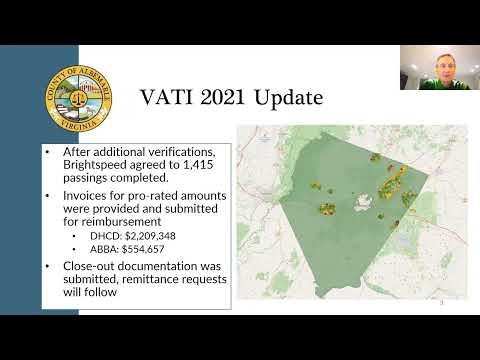
Staff reported roughly 171 miles of fiber completed and said contractors have added another 10 miles recently. However, much of that installed fiber remains untested, and staff said service cannot be activated until testing and middle-mile connections are completed. One presenter said certain project areas—two identified project zones accounting for about 1,000 premises—are delayed while partners identify acceptable sites for fiber huts and related infrastructure.
The authority was told the backbone and middle-mile work are tracked separately and may finish on different schedules. Staff explained that middle-mile installation and subsequent testing are on the critical path: even if middle-mile construction is largely finished by late summer, testing and last-mile work can push the date when customers can order service well beyond those milestones.
Board members asked what drives fiber-hut siting issues. Staff said suitable physical footprints (for example, 20-by-20 pads and small equipment buildings) are required; options under consideration include leasing private land or using fire stations as host sites, though members expressed reservations about placing that equipment at stations. The authority heard that some locations require additional permitting or rights-of-way work, which remains unresolved in a small number of communities.
On funding and procurement, staff said the project team plans to request an extension through June 2026. They noted that would still precede an anticipated expiration of certain ARPA-related funds in December 2026, but that any extension and final awards depend on federal approvals—staff specifically cited NTIA review and the Department of Commerce guidance that led to reopening of some application rounds. Staff described a second negotiation cycle in which original awardees will be re-notified and may bring partners to reach required thresholds; prior project work may receive credit under scoring rules if bids fall within prescribed ranges.
The authority also heard that the equity act funds and a digital-skills workforce program have been paused temporarily; staff said applications will be reviewed and held until funding or next steps are clarified. One presenter noted roughly $400,000 is being used to support regional design work and outreach in the near term.
The meeting closed with board members agreeing to monitor construction updates, testing milestones and NTIA-related approvals. No final service-activation dates were announced; staff said they would provide further updates at the next regular meeting.