
Acton finance committee reviews FY2026 first‑quarter report; collections and debt service highlighted
Get AI-powered insights, summaries, and transcripts
Subscribe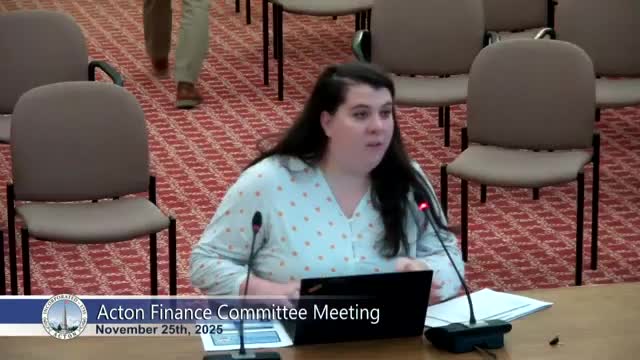
Summary
Budget director Ellie Anderson reported Q1 FY2026 collections through September — $29.79M in property taxes (25.85% of target) and mixed results across enterprise and revolving funds — and explained a higher first‑quarter sewer expenditure share tied to new debt service for the sewer plant rehabilitation.
Ellie Anderson, Acton’s budget director, presented the Town of Acton’s FY2026 first‑quarter financial report, covering results through September. Anderson said the town has collected $29,787,000 in property taxes, representing 25.85% of the annual target, $292,000 in state aid (17.7% of that target) and just over $1,000,000 in local receipts (16.84% of a $6.5 million target). She told the Finance Committee that free cash has been submitted to the Department of Revenue and that last year’s certification was $5.1 million.
Anderson summarized general fund spending and enterprise and revolving fund activity. The FY2026 operating budget totals $40.8 million, with $13.6 million spent year to date (33.36%). She cautioned that first‑quarter percentages can appear high because the Middlesex County retirement assessment is paid in full on July 1.
On enterprise funds, Anderson gave line‑by‑line figures: the Septage enterprise has a ~$166,000 budget and has used retained earnings to smooth operations; the Transfer Station (budget $992,725) has collected roughly $319,000 through September (47.66%) but also includes a $225,000 capital allocation for equipment this year; the Sewer enterprise’s approved budget is just over $2.5 million with collections under half of projected fees and expenditures of roughly $678,000 (26.21%). Anderson said the larger year‑over‑year sewer expense is substantially driven by debt service tied to a sewer plant rehabilitation project.
Committee members pressed Anderson on the sewer figures. A member asked whether the increased sewer debt payment is an operating or capital expense; Anderson replied, “The debt is a part of that $2,500,000 budget approved at Town Meeting,” and explained that timing of July 1 debt payments makes the first‑quarter percent spent higher.
Other enterprise highlights included the ambulance fund (budget just over $2 million; 26.19% collected, 17.63% expended) and the Transportation enterprise (budget $565,599) that receives a $100,000 commuter lot subsidy; Anderson said LRTA reimbursement timing can affect reported revenues.
Anderson also reviewed revolving funds, noting variability in year‑to‑date collections and that some funds typically receive the bulk of revenue later in the fiscal year. For example, the recreation revolving fund had collected nearly $160,000 but spent $438,568, reflecting seasonal camp spending; stormwater inspections revenue was $22,040 and includes $100,000 budgeted for a stormwater management utility study.
On accounting mechanics, Anderson told the committee that revolving funds do not have separate bank accounts; balances and deficits are tracked in the town’s Munis accounting system and shortfalls are bridged by each fund’s balance. “If this account ended for the year, that gap would be bridged by the fund balance that it has on hand,” Anderson said.
Anderson said the FY2024 audit is posted on the town website and that the FY2025 audit is underway. She noted free cash was submitted to DOR in October and that certification may be delayed by state tax‑rate work this season.
The Finance Committee did not vote on any budgets or policy changes during the meeting; members asked for additional details and follow‑up on debt timing, the composition of the sewer increase, and a more detailed breakout on health insurance assumptions for the forecast.
The committee adjourned after confirming upcoming meeting dates.