
Franklin County wrestles with $813,000 2026 budget shortfall as insurance and public-defense mandates bite
Get AI-powered insights, summaries, and transcripts
Subscribe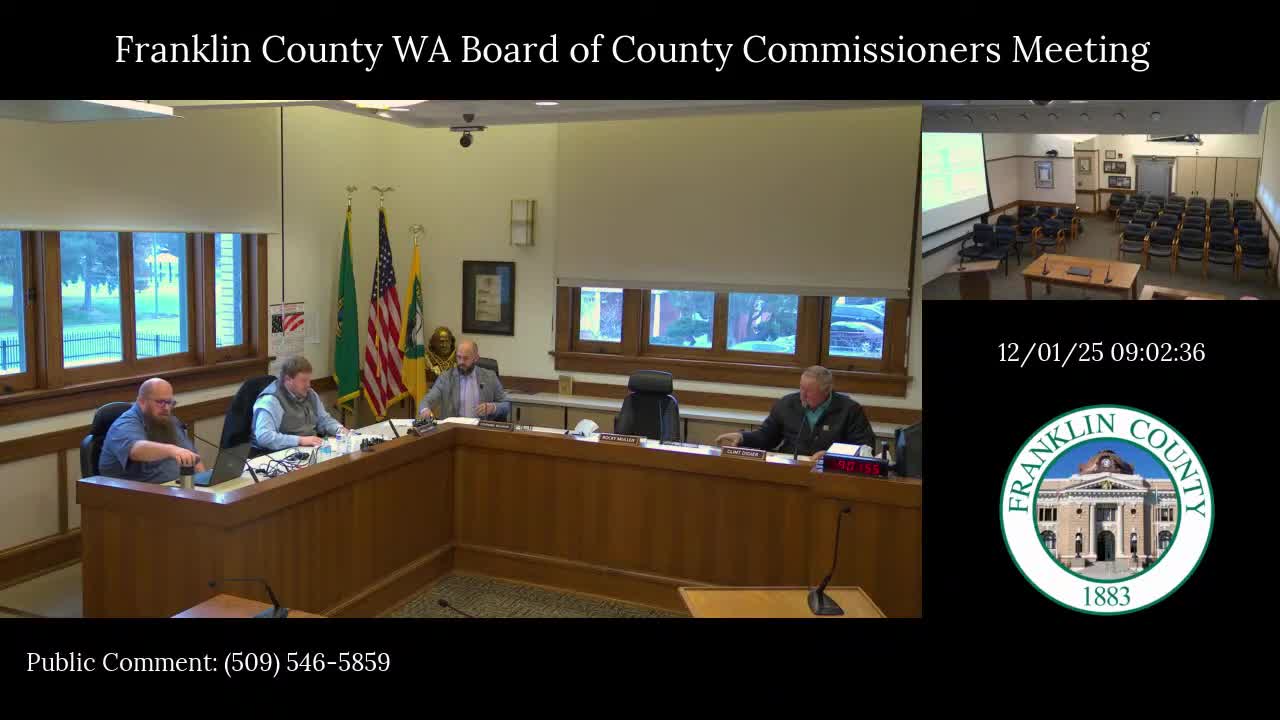
Summary
Commissioners met to finalize the 2026 budget, confronting an $812,995 deficit driven mainly by a 55% jump in liability insurance and higher indigent-defense and corrections costs. They discussed targeted cuts, attrition, reserve adjustments and shopping insurance as immediate fixes before adopting levy certifications.
Franklin County commissioners continued a second day of budget talks to close an $812,995 projected shortfall for the 2026 fiscal year, as officials laid out a series of options including targeted cuts, attrition and limited use of reserve funds.
The deficit stems from several large, partly unexpected items, county auditors and officials said. The most immediate was a 55% increase in the county's liability insurance premium, which commissioners and the auditor described in the meeting as roughly $640,000—640% above what was budgeted and contributing the single largest hit. Auditor Tim Anderson said the insurance increase added roughly $274,000 in nondepartmental insurance liability and contributed to a broader $680,000 increase the county is seeing in risk costs.
County leaders also cited mounting costs tied to the Office of Public Defense (OPD), where a state supreme court mandate has forced greater local spending on indigent defense services. Anderson said Superior Court had requested increases that reached $650,000; the auditors had provisionally added $325,000 of that request to the preliminary budget while warning the board it might need the full amount. Commissioners described OPD as a structural, state-driven pressure that requires engagement with judges, the prosecuting attorney and OPD to explore long-term fixes.
Corrections accounted for another major gap. Anderson reported a net $550,000 hit in the corrections budget driven by reduced transfers in (down $190,000) and $364,000 of new expenditure requests, including medical and professional services. Commissioners explored holding vacancies open and using attrition to reduce headcount as a near-term approach to save roughly $100,000 per FTE in salary-and-benefits costs; the board estimated that four attritions in corrections could yield about $400,000 toward the shortfall.
County staff and elected officials proposed a mix of near-term and structural responses: push attrition where possible, re-evaluate selective vacancies, delay or reduce discretionary spending, accelerate revenue opportunities (for example rolling out inmate tablet/commissary programs to capture new revenue), and consider a smaller-than-planned transfer to the reserve fund for the coming year. The board asked staff to prepare a short report showing where departmental growth and new positions have occurred in recent years to target nonessential growth for cuts.
On insurance, commissioners approved giving staff permission to "shop" the county's risk coverage; Tim Anderson said a year's advance notice is typically required to seek new carriers or adjust pool participation. The board discussed raising deductibles to reduce premiums but recognized that rising jury awards and payouts across the region have driven broader increases in the risk pool that a deductible change may not fully offset.
Several commissioners urged greater transparency for taxpayers, asking that levy certifications and taxing district requests be posted online so residents can see which local entities are seeking property-tax levies and how those levies affect household bills.
What happens next: county staff will return with a set of options and a targeted list of candidate positions or budget lines for reduction. The board emphasized that the adopted budget can be amended and that limited, temporary use of reserves or postponing portions of the $1.4 million reserve transfer remain on the table while staff double-check numbers and pursue revenue offsets. The auditor stressed the need to meet statutory deadlines for certifying taxing-district levies, which the commissioners later approved with the caveat they would follow up on disputed items.
The hearing remains open; commissioners set a follow-up work session to finalize decisions and to meet again with counsel and affected department heads.