Get Full Government Meeting Transcripts, Videos, & Alerts Forever!
Get email alerts on the Budget topic
No spam. Unsubscribe anytime.
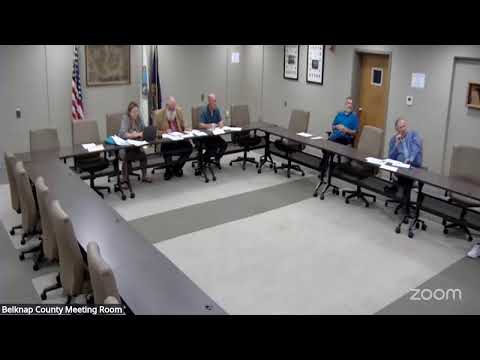
Belknap County executive committee hears 2025 budget update; staff project roughly $1.7M boost to fund balance
Summary
County staff told the Belknap County executive committee that 2025 revenues and expenditure variances could add roughly $1.7 million to next year’s fund balance, driven by nursing-home ProShare receipts and several department surpluses; no formal budget action was taken.
Belknap County executive committee members heard a budget update in which county staff projected a series of department surpluses that, if sustained, could contribute about $1.7 million to next year’s fund balance.
Speaker 2 (Unidentified Speaker), who presented the budget summary, said the county’s revenues and expenditures now project a combined positive position. “The total general fund is expecting, excess of revenues to the tune of $473,000,” Speaker 2 said, and the nursing home is “expecting a surplus also of, over a half million dollars,” driven in part by ProShare receipts and a larger-than-typical state cap credit allocation.
The presentation broke results down by department. Speaker 2 reported a modest corrections revenue shortfall of $9,500 and said that the corrections office’s revenue had been overestimated during the budget process. The sheriff’s office was projected to show a surplus of about $30,000 because of wages and benefit changes and potential tower rental income. County maintenance showed a small projected deficit—about $1,600—attributable to unplanned repairs and fuel costs.
Nursing-home lines were mixed: Speaker 2 described a sizable savings from reduced use of travel nurses (about $462,000) and an overall nursing-home surplus estimate near $400,000, but also said dietary services could face a deficit in the neighborhood of $125,000 following a vendor change. On balance, Speaker 2 summarized that surplus revenues and expenditure variances could contribute “about 1,700,000.0 to next year's fund balance,” which staff said would be helpful in setting the 2026 budget.
Board members asked about budget timing and benchmarks. Speaker 3 asked what spending percentage would be appropriate at this point in the year; Speaker 2 replied that the benchmark is 73 percent and noted that some utility lines were already at about 82 percent spent. Regarding corrections staffing, Speaker 3 asked whether filling vacancies would erode the projected surplus; Speaker 2 said the projection assumes positions will be filled and that the surplus estimate stands under current assumptions.
Outside-agency payments were also discussed. Speaker 2 said some organizations — including CASA and others — had not yet requested their allocations and that staff would contact them to request invoices. The packet did not include one reported on-balance total (Speaker 2 said the current on-balance amount was about $5.5 million and that figure was not reflected in the distributed packet).
No formal vote on the budget was taken during the session. The meeting included a motion (and second) to approve executive minutes early in the agenda and concluded with a motion to adjourn; the clerk noted no formal tally was recorded for the minutes approval and that no vote was required to adjourn.
Next steps were not detailed in the discussion beyond staff follow-up to request invoices from outside agencies and the regular budget-setting process for 2026.