Get Full Government Meeting Transcripts, Videos, & Alerts Forever!
Get email alerts on the Housing Needs Assessment topic
No spam. Unsubscribe anytime.
Land of Sky presenter: region faces roughly 34,000-unit housing shortfall by 2029
Summary
Jacob of the Land of Sky Regional Council told a Buncombe County committee the 2025 Housing Needs Assessment estimates more than 34,000 additional housing units are needed by 2029 — including about 14,000 rental units — and urged policy changes such as zoning reform and support for prefab and manufactured housing to close the gap.
Jacob, a representative of the Land of Sky Regional Council, told Buncombe County committee members the region faces a substantial housing shortfall that will require coordinated policy and market responses.
"We have over 34,000 units that are gonna be needed by 2029," Jacob said, adding the study shows roughly 14,000 of those should be rental units and a little over 20,000 for-sale units. He said the assessment draws on Census, American Community Survey and stakeholder survey responses and updates earlier 2015 and 2020 reports.
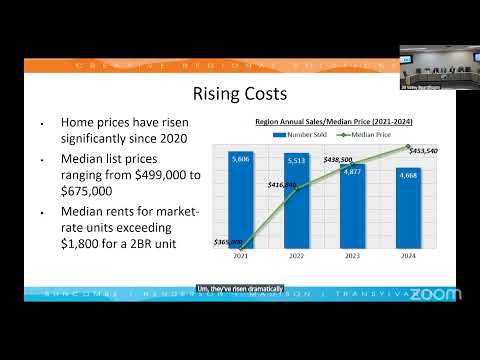
The presentation summarized key demographic and market findings: the region’s population is approaching the half-million mark, median household income cited in the presentation runs below the state average (presenter gave a comparison around $67,000 locally versus $74,000 statewide), and market-rate rents and home prices have risen faster than wages. Jacob said the study found about half of renters are cost-burdened and that 10–20% are severely cost-burdened.
Jacob challenged a recent local news report’s characterization of vacancy rates, noting the assessment measured 3–4% vacancy during the study period and that a healthy market typically shows about 7% vacancy for churn. He said a reported 10% vacancy rate appears concentrated in higher-end units and is not solely attributable to storm-related displacement.
On specific housing types, Jacob said manufactured or park-model homes remain an important affordable option and noted that many manufactured units were damaged or displaced after recent storms. He also highlighted alternative building types and quick-delivery models: "There's a company down in Fletcher that's called Compact Cottages," Jacob said, describing modular or prefab cottages as a potentially quicker, lower-cost route to add supply.
Jacob said the pipeline of planned development — roughly 4,000 multifamily units and about 434 for-sale homes cited in the study — targets mostly higher-end markets and will not close the affordability gap. He also flagged a projected need for about 7,700 senior care beds or units by 2029 that sits outside the general 34,000-unit estimate.
Surveyed stakeholders (about 48 respondents including nonprofits, lenders and local government staff) prioritized down payment assistance, home repair programs and renter security-deposit assistance; Jacob said the consensus favored preserving existing stock and targeted construction rather than only building high-end units.
Committee members asked about site selection, zoning barriers and policy models. Jacob pointed to examples such as Durham and Hendersonville where zoning adjustments, reduced parking minimums and easier accessory-unit rules helped expand housing options.
The presentation concluded with Jacob noting slides and additional materials are available and providing contact information and web links for the assessment. The committee followed with further questions but took no formal vote on the study at the meeting’s close.