
Consultant finds full electric transition for Mountain Mobility would need far larger fleet and major facility upgrades
Get AI-powered insights, summaries, and transcripts
Subscribe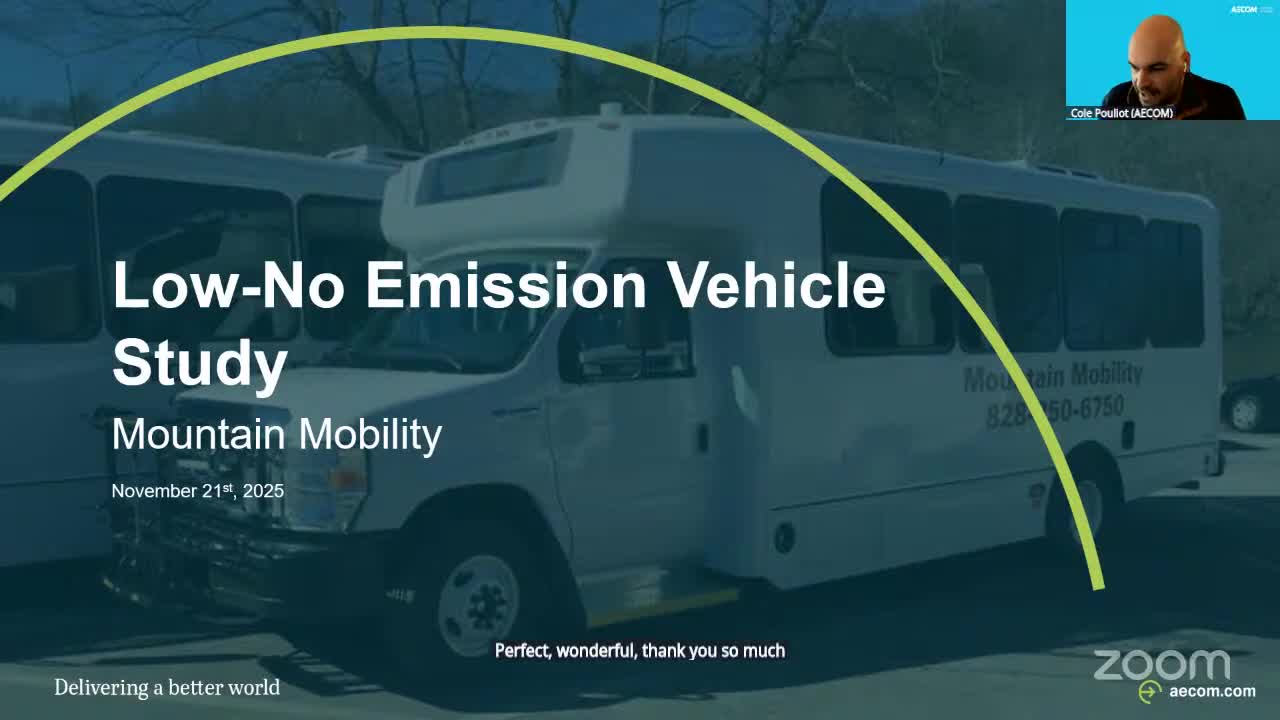
Summary
A county‑funded study presented to the committee found that converting Mountain Mobility’s small paratransit/cutaway fleet entirely to zero‑emission vehicles would require nearly a 300% fleet increase and roughly $64 million in added capital, and that existing leased Riverside facilities lack power and maintenance space for such a transition.
BUNCOMBE COUNTY — County transportation staff and consultants briefed the committee on a two‑year low‑ and no‑emission vehicle study for Mountain Mobility, concluding that a full zero‑emission transition is currently impractical without major fleet and facility changes.
William, Buncombe County’s transportation planner, introduced Cole, the consultant who led the study funded by the North Carolina Department of Transportation. Cole said the study included facility evaluations, vehicle‑route emissions and financial modeling, and stakeholder engagement.
The report found that Mountain Mobility’s smaller cutaway/paratransit vehicles face range and battery storage limits that would require increasing fleet size by nearly 300% to maintain current levels of service if the county moved immediately to a 100% zero‑emission fleet. Cole said that translating the model to procurement terms produced an approximate incremental capital cost of about $64,000,000 compared with continuing the current fleet configuration.
Cole described three key constraints at the county’s Riverside operations site (2000 Riverside Drive): limited electrical capacity at the site, high flood risk that complicates equipment siting, and the fact the property is leased, which makes major permanent infrastructure investments difficult without the landowner’s agreement. The site also lacks dedicated vehicle maintenance bays suitable for advanced drivetrains, which would make ongoing operations and repair more challenging.
Given those findings, Cole recommended the county consider acquiring or using a county‑owned facility in lower‑flood‑risk areas and creating internal maintenance capacity (either Mountain Mobility or county staff) to reduce barriers to adopting low‑emission technologies over time. Committee members asked about hybrids, CNG and biodiesel; staff and consultants said hybrids of the cutaway size are not widely available, biodiesel is not classified by FTA as a low‑emission technology, and CNG/propane conversions remain viable but require fueling infrastructure.
No immediate fleet procurement decisions were made; the presentation was framed as a technology and procurement briefing to guide future contract and capital planning.