Get Full Government Meeting Transcripts, Videos, & Alerts Forever!
Get email alerts on the Policy 3522 topic
No spam. Unsubscribe anytime.
Parents, students and advocates urge Blue Valley to clarify Policy 3522 on emergency safety interventions
Summary
Multiple parents, students and local advocates told the Blue Valley Board of Education on Oct. 13 that Policy 3522 — which governs emergency safety interventions and restraint — can punish compassionate responses to children in mental‑health distress and urged clearer language to preserve professional judgment and student dignity.
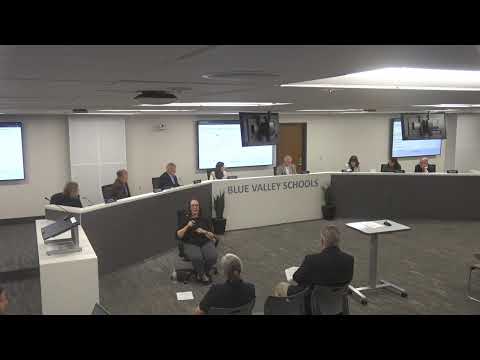
Several parents, students and advocates urged the Blue Valley Board of Education on Oct. 13 to revise Policy 3522 so school staff can respond compassionately to students experiencing severe emotional distress without risking discipline.
At the board's open forum, Jenny Stille, a Lakewood Middle School and Blue Valley parent, said the district's policy "supports teachers in treating kids in dysregulated states of mental trauma with such a lack of compassion and dignity," and asked the board to ensure that humane, de‑escalating responses are not treated as punishable restraints.
"If compassionate responses to these mental needs are punishable under Policy 3522, then the system is failing both our teachers and our students," Stille said.
Other speakers described similar concerns. Casey Etalin, a parent of two Blue Valley students, asked whether calmly guiding or briefly carrying a very young, voluntarily cooperative child to a quieter space for comfort would be classified as a restraint under the current language. "When done voluntarily, safely and without resistance, this should not be classified as restraint," Etalin said, urging clearer definitions and room for professional judgment.
Longtime educator Kathy Wiley urged the board to consider intent and individual circumstances before imposing severe employment outcomes. "A policy that allows for one and only one outcome without taking into account the intent behind the policy really has no place in a district as esteemed as Blue Valley," Wiley said.
Parents argued the current policy can produce unintended consequences: isolating a child in crisis, discouraging teachers from stepping in, and signaling to other students that adults will "pull away" when a classmate is in distress. "We need to trust our teachers," said Carrie Fernando, a parent, "and equip them with the necessary training and support."
Speakers repeatedly framed the issue as both a student‑safety and professional‑judgment concern. Several called for explicit language distinguishing emergency physical danger (where restraint may be necessary) from emotional dysregulation, and for a continuum of responses and supports — such as rapid access to mental‑health staff — rather than a single punitive path. Kathryn Goodwin, a recent Blue Valley graduate and student‑advocate, combined personal testimony with data to press for prevention and education alongside policy changes.
Board members acknowledged the comments and the complexity of aligning local policy with state law and rules. One board member noted that some elements of the policy are driven by higher‑level laws and regulations, which constrains how district policy can be worded. The board invited staff to review the concerns; no formal changes were adopted that night.
The public comments on Policy 3522 were part of a broader open forum that also included requests for consent education in the curriculum and a separate book‑challenge. The board said it has recorded comments and will follow up with speakers as appropriate. The item will proceed through the district's policy review process for future consideration.