
Board approves consent agenda: adaptive-reuse project, tenant-relocation updates and multiple grants
Get AI-powered insights, summaries, and transcripts
Subscribe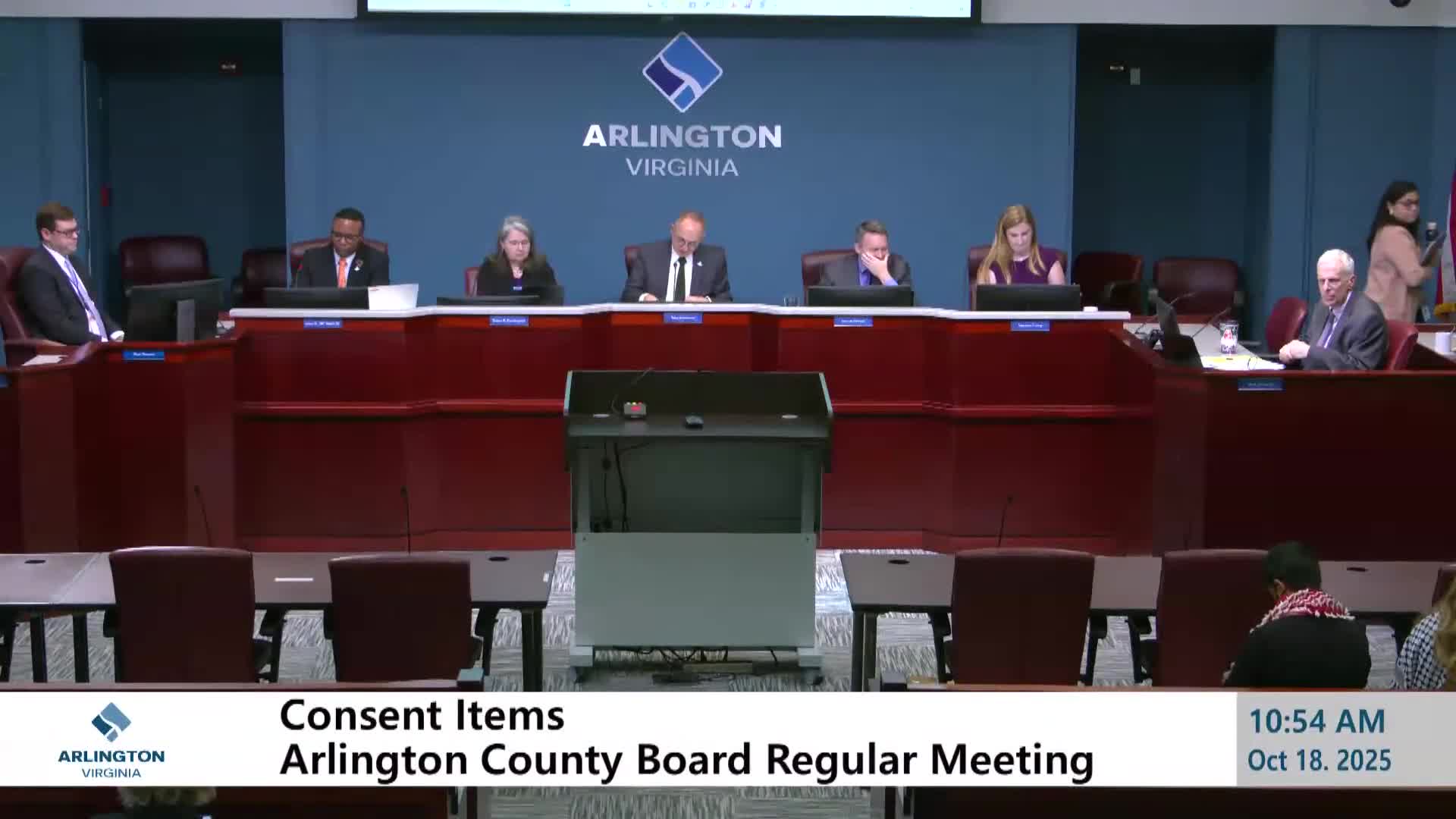
Summary
The Arlington County Board unanimously approved its consent agenda, advancing an adaptive-reuse project that would add 296 residential units at 4100 Fairfax Drive, updating tenant-relocation guidelines, expanding stormwater credits to homeowners associations, and accepting multiple grants including $1.2 million in FHWA funds and $38 million in state transportation funds.
The Arlington County Board voted unanimously to adopt the consent agenda, approving a range of noncontroversial items the manager recommended while pulling two items (9 and 20) for separate hearings. The consent agenda included an adaptive-reuse project at 4100 Fairfax Drive that converts roughly 250,000 square feet of underused office space into 296 residential units and reduced the Boston office-market vacancy by roughly two percentage points.
The board also approved updates to the tenant relocation guidelines, which add household and transportation details to tenant profiles, increase staff oversight of a point system used to prioritize returning tenants and raise displacement payment amounts to align with the highest schedules in the Washington, D.C., metropolitan area.
Other consent actions included an amendment to the stormwater-utility credit program to allow homeowners associations to qualify their common areas for voluntary credits, an update to EMS fee waivers to tie eligibility to HUD Section 8 income determinations and a set of grants and funding acceptances: $550,000 for after-school program awards to three providers; $475,000 in CDBG funds for additional MIPAP down-payment assistance (serving up to five households earning up to 80% AMI); $1.2 million in FHWA commuter-services funds; $38 million in Commonwealth Transportation (state) funds for local capital projects; and $74,000 in Virginia Highway Safety Program funds for traffic enforcement programs.
Board members highlighted community concerns raised during public comment, including housing discrimination testing and tree canopy protection, and invited residents to upcoming public engagement events on the county's low-density residential study and the public-spaces master-plan refresh.