
Boyle County Fiscal Court sends proposed agricultural zoning amendment back to planning commission
Get AI-powered insights, summaries, and transcripts
Subscribe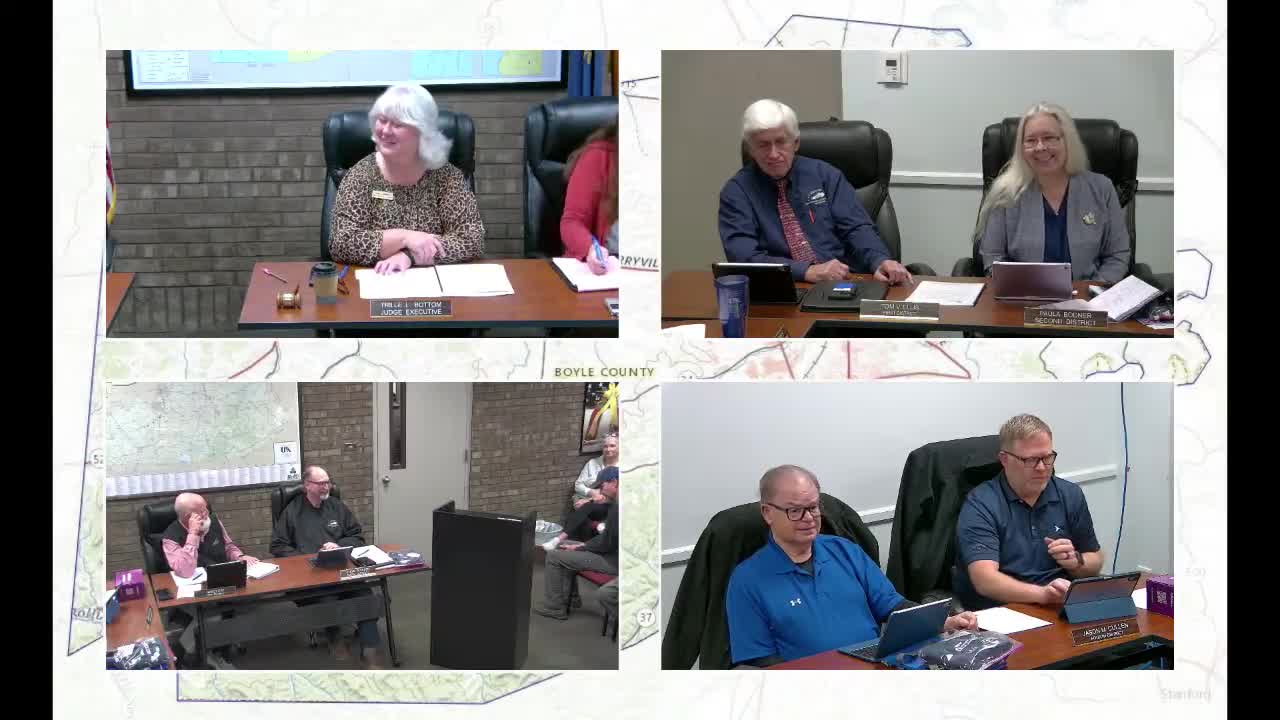
Summary
After a lengthy public discussion and concerns about notice and farmland impacts, the Boyle County Fiscal Court voted Nov. 25 to deny a proposed zoning-text amendment as presented and return it to the Planning and Zoning Commission for further work, including consideration of a minor/final plat option and broader stakeholder input.
The Boyle County Fiscal Court voted Nov. 25 to deny a proposed text amendment to agricultural zoning as presented and to return the measure to the Planning and Zoning Commission for further study and stakeholder outreach.
Planning and design director Hannah Gray told the court the Danville County Planning and Zoning Commission met Oct. 22 and recommended a zoning text amendment that would increase the minimum lot size in the agricultural zone (presentation cited an increase from 1 acre to 5 acres and an amendment to section 4.305 to align with the adopted 2025 comprehensive plan). Several magistrates and members of the public raised concerns about insufficient public notice, the potential financial impact on farm families and the lack of specific frontage and road-frontage standards in the published materials.
Magistrates urged broader outreach to farmers, developers and landowners and recommended reconvening a small stakeholder committee to consider alternatives, such as reviving the prior minor/final plat option and exploring buffer or clustering approaches. Multiple court members referenced the county’s recently updated comprehensive plan and emphasized that planning recommendations deserve careful study under KRS 100 procedures.
Magistrate Collins moved to deny the amendment as presented and send it back to Planning and Zoning with instructions to consider alternatives and more public engagement; the motion carried by voice vote. Several magistrates asked for clear advertising and public communication about any revised proposals before future votes.
The court’s vote does not adopt any zoning changes; it returns the proposal to the commission for additional analysis, stakeholder input and clearer public notice before the fiscal court considers it again.