Lifetime Citizen Portal Access — AI Briefings, Alerts & Unlimited Follows
Calhoun County task force pushes BEAD applications, plans letters of support and digital‑equity steps
Loading...
Summary
Calhoun County’s broadband task force reviewed federal and state policy shifts affecting BEAD grants, agreed to coordinate letters of support for ISP applications due in early April, and heard a digital‑equity update on device distribution and training programs.
Calhoun County’s Broadband Task Force on March 17 reviewed national and state telecommunication developments and moved to marshal local support for upcoming federal BEAD grant applications.
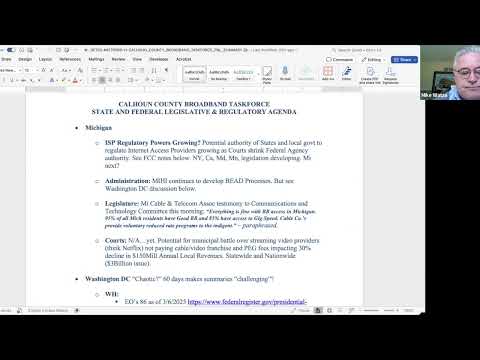
Telecom counsel Mike Wattsa briefed members on a shifting regulatory landscape that he said could leave more authority to states and local governments and prompt changes in BEAD rules. "If you change the game now, you open up all kinds of issues with the applications that are due," Wattsa said, warning that proposed changes in Washington could reduce contractor requirements, alter DEI and local‑hire incentives, and broaden eligible technologies to include fixed wireless and satellite.
Chair Lynn (meeting chair) told members Calhoun’s mapping work shows "over 14,000 eligible locations" in the county and about 248,000 statewide for BEAD funding. She described the first BEAD round as focused on fiber‑to‑the‑home and noted application deadlines cited during the meeting as April 7 and April 9. "The first round is due for April 9, and that first round is specifically for fiber to the home," she said, while other members referenced an April 7 date; the county flagged both dates for members to verify.
The task force agreed to help Internet service providers with letters of support and recommended that townships authorize supervisors or governing bodies to approve and sign those letters so applications receive points from the state review process. Kelly Scott, county administrator/controller, said governing‑board approval is generally required for letters sent by local governments and encouraged members to adopt simple authorizing resolutions: "That's a great idea…get authorization so that there's a resolution on record that it was approved by the governing board," she said. The chair offered a draft resolution and said she would compile ISP drafts into a single email for members.
Angela Semifero, chair of the digital equity subcommittee, outlined stopgap measures while infrastructure is built: partnerships with device refurbishers, expanding Albion College AmeriCorps tech‑savvy senior programs, monthly drop‑in tech help at township halls, and potential mini‑grants administered through Calhoun County senior services. She cited programs such as Human I.T. and TechSoup as models for device redistribution and low‑cost software access.
Frontier representative Todd Cruise, attending during citizen time, said Frontier is finalizing hex‑bin maps for its application and offered to assist with crafting locally specific letters. He also said Frontier is in the process of being acquired by Verizon; if the transaction completes, any BEAD obligations won by Frontier would transfer to Verizon.
Procedurally, members approved the December meeting minutes by voice vote. Next steps the task force identified: finalize and circulate draft letters and a county resolution to authorize supervisors to sign letters of support; meet individually with ISPs (the county said it will meet with Comcast this week); and continue digital equity outreach and device programs.
The task force closed the meeting after the scheduled agenda.