
Cartwright board delegates authority to appoint hearing officers for two personnel hearings
Get AI-powered insights, summaries, and transcripts
Subscribe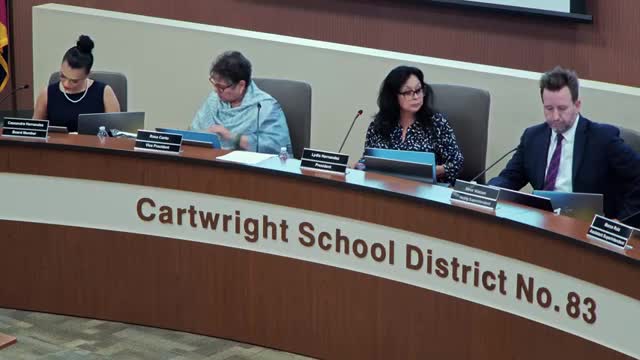
Summary
The governing board voted to delegate to the acting superintendent the authority to appoint hearing officers from a State Board of Education list for hearings on amended statements of charges adopted Oct. 27, 2025, concerning Deputy Superintendent/Chief Financial Officer Victoria Farrard and the deputy superintendent of human resources and educational programs.
The Cartwright Elementary District governing board on Nov. 5 delegated authority to the acting superintendent to appoint independent hearing officers to conduct personnel hearings arising from amended statements of charges the board adopted Oct. 27, 2025.
Acting Superintendent Watson explained the district will select hearing officers from a list provided by the Arizona State Board of Education — a pool of certified individuals trained to serve as independent arbiters in employee due‑process hearings. For the financial officer matter, the board moved to allow the acting superintendent to appoint either Harold Merkel, Benson Hufford or Rob Haas to serve as hearing officer in the hearing regarding the governing board's amended statement of charges against Deputy Superintendent and Chief Financial Officer Victoria Farrard. The board approved the delegation by recorded vote.
On a related personnel item, the board similarly delegated appointment authority for a hearing regarding the deputy superintendent of human resources and educational programs; proposed hearing officers included Harold Merkel, Vincent Hubbard and Rob Haas. Board members discussed the purpose of using independent hearing officers — described by administration as an impartial party to hear evidence and make a recommendation back to the governing board — rather than the board conducting the hearing itself.
Board President Lydia Hernandez moved for the delegations; motions were seconded and carried with members present voting 'aye.' The actions do not itself determine guilt or employment outcomes; they only authorize appointment of hearing officers and continuation of due‑process proceedings.