
Chesterfield County officials review tighter rules for solar farms, including wire removal, bigger bonds and stricter screening
Get AI-powered insights, summaries, and transcripts
Subscribe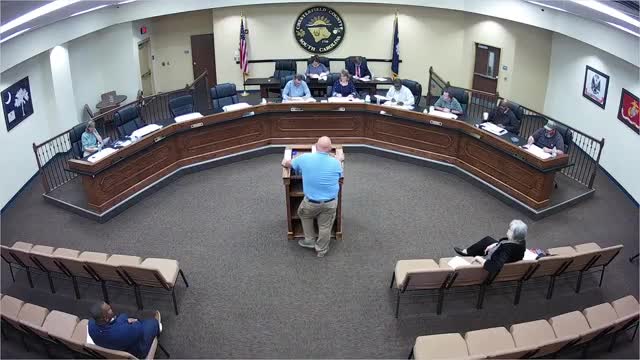
Summary
County committee discussed changes to local solar-farm rules: require removal of buried wiring at decommissioning, raise performance bonds from 125% to 200%, strengthen buffers/opaque fencing and immediate visibility standards, add battery siting rules, require FAA letters for airport-adjacent sites, and improve internal-road and notification requirements.
Speaker 1 opened a meeting of Chesterfield County officials to review proposed revisions to the county's solar-farm ordinance and asked Speaker 2 to summarize recommended changes. Speaker 2 said the proposals were developed with input from 'Libby' and would be coordinated with PD COG before being brought to full council for three readings.
The package centers on decommissioning and community protections. Speaker 2 proposed requiring companies to remove all buried wiring at the end of a project's life, rather than cutting cable and leaving it underground: "My proposal is that we require them to remove all wire." He also proposed increasing the decommissioning performance bond from the current 125% to 200% of the third-party estimated decommissioning cost and requiring a third-party engineer to verify estimates and take soil samples to ensure land is restored.
Aesthetics and neighbor impacts were a recurring focus. Speaker 2 asked to upgrade screening where solar farms abut residences, schools, churches and county roads — moving from a lesser 'buffer zone B' to stronger 'buffer zone C' or requiring opaque fencing behind vegetation. On screening timing he emphasized immediate effectiveness: "I want it to cut off visibility at the time of completion of the solar farm. Not 20 years from now." Speakers noted that vegetation alone can take many years to mature, so the ordinance would need specifications to ensure screening is effective at completion.
Battery storage drew attention as an area with no existing local standards. Speaker 2 said batteries currently could be placed on the ground under county rules and said EPA rules also apply; he proposed researching siting and containment requirements and told the committee: "If y'all give me the go ahead, I will have they'll have to be in buildings." Committee members raised environmental concerns about battery chemistry and past lead-acid systems, and Speaker 2 agreed to include research and recommended language in the draft.
Other technical and safety proposals include naming internal, private roads within solar farms and adding them to the county GIS with assigned addresses to aid emergency responders; requiring 60-foot-wide all-weather internal roads and a 100-foot cul-de-sac or turning radius to accommodate fire apparatus; and increasing setbacks from property lines from 100 feet to 200 feet where panels abut houses, churches or schools. Speaker 2 also proposed pollinator-friendly ground cover to help offset habitat loss and an increase in the size of zoning signs.
On process, Speaker 2 proposed mandatory notification of adjacent property owners, schools and churches and requiring solar companies to hold a question-and-answer meeting with nearby landowners funded and organized by the company. He also recommended requiring an FAA letter for projects in or near airport districts to allow aeronautical review.
Committee members asked whether projects already approved or with issued construction permits would be grandfathered; speakers clarified projects without issued permits at the time a new ordinance takes effect would have to comply with the new rules. The group agreed staff (Speaker 2) should work with PD COG to draft a full package and return recommendations to the full council; no final ordinance vote took place at this meeting.
Procedural votes at the start and end of the meeting included the adoption of the agenda, approval of Oct. 10 minutes, and a motion to adjourn; those routine motions passed by voice vote. The committee scheduled follow-up work and signaled staff to coordinate with PD COG and prepare materials and summaries for council consideration.