Cheektowaga adopts short‑term rental law amid county opt‑out concerns; severability questioned
Loading...
Summary
The Town Board adopted Local Law 5 of 2025 regulating short‑term rentals, but members and residents flagged potential preemption by Erie County if the county does not opt out; sponsors and the supervisor said the law can be revised if county rules require changes.
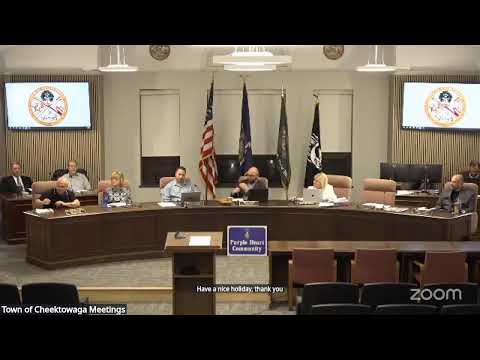
The Cheektowaga Town Board voted on Nov. 25, 2025 to enact Local Law 5 of 2025, a local law creating Chapter 201 of the town code to regulate short‑term transient occupancy in residential neighborhoods.
The resolution, sponsored by Supervisor Brian Nowak and several council members, declares the town’s interest in regulating short‑term rentals to protect neighborhood character and public welfare. Resident commenter Gary Bork urged caution, saying the county must opt out by Dec. 31 for towns to adopt registration schemes: "If the county does not opt out by December 31, I don't think we can adopt a registration law," he said during public comment.
Board members discussed that risk and whether a severability clause should be added so parts of the local law could remain effective if other provisions are preempted by county or state action. Supervisor Nowak said the board could revisit the law if necessary; one member noted that other municipalities (including a village version) have acted and that enforcement and registration practices at the county level are inconsistent.
A roll‑call was recorded on the measure. The motion carried; council members recorded in the transcript as voting "yes" included Barbara Bukowski, Diane Benczkowski, and Polarski; Council member Vernon Thompson signaled a preference to abstain, and Supervisor Nowak recorded a "yes." The law requires certain registrations and references county registration rules and a timeline for compliance. Town staff said the Secretary of State filing process typically takes about three weeks.
The board and speakers emphasized that, even if county rules or later court interpretations change parts of the law, the town can amend language or add a severability clause and that other substantive operational standards (noise, occupancy limits, and other property‑use regulations) could still be enforced regardless of registration rules.
Next steps: staff will complete any required filings (Secretary of State) and advise on county opt‑out status and enforcement timing; the board indicated it may revisit the law in early 2026 if county or state guidance requires adjustments.