Get Full Government Meeting Transcripts, Videos, & Alerts Forever!
Get email alerts on the Wastewater Infrastructure topic
No spam. Unsubscribe anytime.
Goldsboro council hears wastewater capacity warning; design‑build expansion timeline and meter contract approved
Summary
Engineering staff reported that development proposals could push the wastewater plant close to regulatory thresholds in wet weather; the council heard a six‑year schedule for a design‑build plant expansion and approved a roughly $1.15 million meters contract to improve metering and billing accuracy.
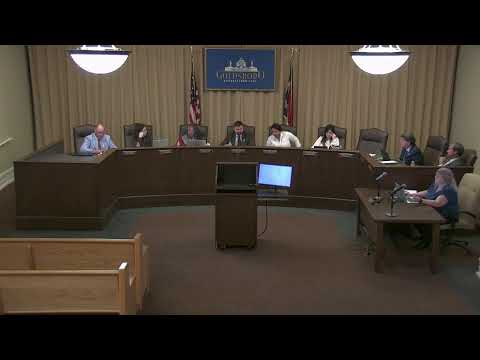
City engineers told the Goldsboro City Council on Oct. 20 that planned development and wet‑weather flows could push the wastewater treatment plant toward regulatory capacity thresholds and that the city is pursuing a multi‑phase design‑build expansion.
Engineering lead Jonathan described the city’s flow‑tracking work and said flow allocations for roughly 2,519 proposed residential units translate into about 192,000 gallons per day in additional demand. Using recent measured influent volumes, Jonathan said fitting those allocations into current operations would place normal conditions near 68.9% of permitted capacity and, under wet‑weather scenarios like 2021, could approach 97.2% of the plant’s capacity.
"Once we hit that 80%, at that point we have to reach out to the state and give them a plan," Jonathan said, summarizing the '80/90' rule: 80% triggers planning and state notification, and 90% requires permits for expansion.
Representatives from the Crowder/Hazen design‑build team told the council the basis‑of‑design and geotechnical work will take about a year, design and permitting roughly 18 months, a guaranteed maximum price phase about six months and construction about three years — a roughly six‑year timeline from notice to proceed to full implementation for an estimated 3.4 MGD increase.
Council also considered and approved a meters contract that had one bid of approximately $1.15 million. Staff explained they will have in‑house crews complete a water loop segment to save costs (estimated $170,000) and use utility fund reserves to cover a roughly $166,489 shortfall in the project budget. The meters and loop work aim to improve billing accuracy and provide more reliable flow data for capacity planning.
City staff and the design‑build team discussed funding paths, including direct appropriations and the North Carolina Department of Environmental Quality Clean Water State Revolving Fund (low‑interest loans). Design and grant application work is ongoing; staff said additional council decisions on project phases and funding will come in the next 30–90 days.
The council voted unanimously to approve the meters contract and the related resolution.