
Committee presses city over eviction notice at railroad encampment, urges written staff directive
Get AI-powered insights, summaries, and transcripts
Subscribe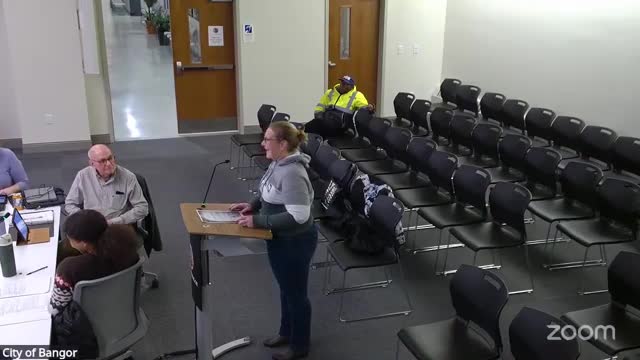
Summary
After a public commenter reported a December 19 notice ordering people to vacate a railroad encampment, the advisory committee criticized outdated resources on the notice, urged more outreach to unhoused residents, and voted to send a joint statement to GovOps while asking the city manager to prepare a staff directive on future responses.
A Bangor advisory committee on equity and human rights spent most of its Nov. 25 meeting pressing city staff for answers after a resident reported that someone had posted a notice on tents at a railroad encampment ordering people to leave by Dec. 19.
"There is a date of the December 19 that people in the encampment need to not be there and all belongings need to be removed, or it will be removed by the city, and they will be facing criminal trespass charges," said Jamie Beck, a resident who raised the item during the meeting's public-comment period.
Beck and several committee members said the notice included inaccurate resource addresses and that outreach to people living in the encampment had been minimal or absent. Committee members described the site as an active rail corridor with emergency-access and winter-safety risks and estimated the encampment houses roughly 40 to 50 people.
Committee members repeatedly encouraged a community-centered approach that follows accepted best practices. "There are 19 strategies for how to deal with encampments," Beck said, referencing guidance from the United States Interagency Council on Homelessness and urging that residents be engaged in planning and compensated for their participation.
Staff said the council had discussed a closure date during a recent workshop and that the Dec. 19 date aligned with the planned opening of a day-warming center. A staff speaker who said she had discussed the matter with city manager Carolyn Lear told the committee she expected staff would "take immediate steps to correct that notice and as well as to make sure that the resources that are actually being provided are accurate and updated." The staff speaker also said the city's homelessness response manager role is newly vacant and that the public-health director and outreach teams were covering those duties while the vacancy is addressed.
Members pressed staff on two lines of inquiry: whether the notices were authorized by a specific city process or issued by another party such as a rail property owner or outreach team, and whether the city had performed the outreach and engagement steps the '19 strategies' recommend before moving to closure. One member hypothesized the notices may have been copies of an older BCAT (outreach team) document being reused with new dates.
The committee discussed whether to push for a formal ordinance or to ask the city manager to issue an internal directive describing the process staff must follow when responding to encampments or requests from third parties. Several members said a city-manager directive or internal memo could put the expected steps in writing and be publicly available if requested; others said a council order would be more formal but might not be appropriate for what staff described as an operational policy.
"If the council was interested in actually directing the city manager to formalize a policy around it, the order driven by council would make sense," a staff speaker said. Committee members noted that an internal directive could clarify responsibilities, ensure newer staff understand required steps, and reduce the risk that outdated materials or unilateral notices are distributed without adequate outreach.
The committee voted to draft a joint statement encapsulating its questions and concerns and to send a representative to present it at the GovOps meeting on Dec. 1 if the item appears on that agenda. The committee's motion to authorize a representative was moved and seconded and carried in a roll-call vote.
Other business included routine updates: planning for a Martin Luther King Jr. breakfast in January, work on a proposed language-access plan, and a request that staff share materials about the paused remote-meeting policy so committees can provide feedback.
The committee asked staff to follow up quickly with the city manager and public-health officials and to report back to the committee with answers about who issued the notices, what outreach occurred, and what immediate steps will be taken to correct and reissue accurate resource information. The committee set its next meeting for Dec. 16.