
Chester council previews austere 2026 budget; no proposed property tax or solid-waste fee increases
Get AI-powered insights, summaries, and transcripts
Subscribe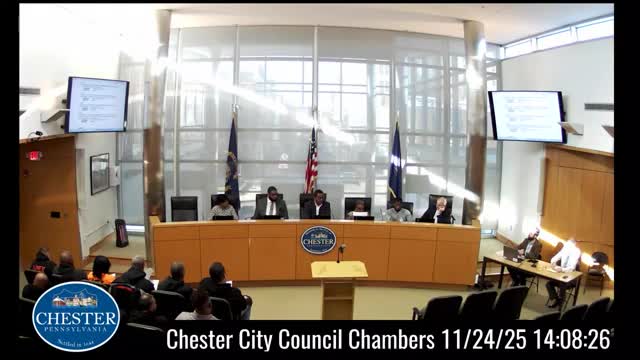
Summary
City officials described the 2026 budget as balanced but austere, noted an estimated $43 million pension liability, and confirmed a first reading Wednesday and a Dec. 8 public hearing (set for 1 p.m.). Council clarified earned-income-tax rates and a 1% Act 205 pension designation.
The City of Chester on Nov. 24 received an overview of the proposed 2026 budget, which officials described as balanced but “austere” and without increases to the city’s real estate tax or its solid-waste fee. The chief financial officer told council the city still carries an unpaid municipal pension obligation from about a decade ago — roughly $43,000,000 — that will influence future budget choices.
“It's a balanced budget. It was austere … There's not really any luxuries in it,” the chief financial officer said, describing the plan as “bare bones” but balanced. He also said the city did not secure its short-term Pennsylvania loan this year — a financing source that in prior years provided between $2 million and $5 million — and that the city is working to address structural needs, including capital reserves.
Council and finance staff confirmed the budget process timeline: first reading of the budget ordinance (B7) is scheduled at the regular meeting this Wednesday; the full budget will be available in the city clerk’s office after that; a deliberative meeting is scheduled for Dec. 8 and the council expects to hold a second reading and finalize the budget at the following Wednesday meeting.
Council members also sought clarification on Bill 10, the proposed earned-income tax (EIT). The council clarified that the resident EIT rate in the draft is 3.75 percent and the nonresident rate is 2 percent; one percentage point of the resident rate is designated under Act 205 to fund distressed municipalities’ pension payments. Council members and staff exchanged brief clarifications about which portions of the rates go to the pension and which flow to the general fund.
Next steps: the council will receive the formal budget ordinance at first reading on Wednesday and will hold a public hearing on Dec. 8 at 1 p.m. in City Council Chambers, after which the second reading and final vote are expected at the following Wednesday meeting.