Get Full Government Meeting Transcripts, Videos, & Alerts Forever!
Get email alerts on the Stormwater Master Plan topic
No spam. Unsubscribe anytime.
Bend staff previews 2025 Stormwater Master Plan, flags $80 million in 20-year needs
Summary
City staff presented the proposed 2025 Stormwater Master Plan and related comprehensive-plan text changes, describing an asset inventory, permitting obligations and programs that would guide roughly $80 million of stormwater projects and programs over 20 years. Commissioners were briefed on outreach and the adoption schedule.
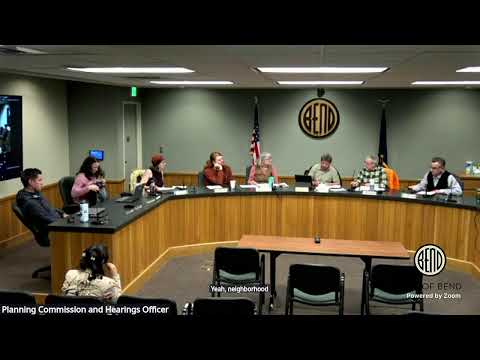
BEND, Ore. — City staff told the Bend Planning Commission on Monday that a proposed 2025 Stormwater Master Plan would replace the city’s 2014 plan, update Chapter 8 of the comprehensive plan, and provide the factual basis for a 20-year capital-improvement program for stormwater.
“These include adopting a new 2025 stormwater public facility plan,” said Damien Srinick, senior planner in the city’s Growth Management division, opening the work session. Srinick described the plan as a compliance and implementation document that inventories pipes, outfalls and underground injection controls and informs a prioritized list of projects.
Lori Fea, the city’s environmental resources manager, and Austin Sameggi, senior project engineer, walked commissioners through the plan’s technical elements. The city’s dispersed stormwater approach relies heavily on underground injection controls — what staff called UICs — including about 7,000 dry wells and roughly 1,000 drill holes across Bend. Staff said roughly 80 miles of storm pipe and 36 outfalls convey runoff where pipes are present; about seven miles of pipe drain to the Deschutes River.
Sameggi said the plan incorporated condition data from closed-circuit television inspections completed for mainline pipes in 2010 and targeted outfall inspections in 2024. Those inspections, plus asset-management records and work-order histories, feed a prioritization matrix that staff used to select capital improvement projects and supporting programs.
“The first phase is visioning, and then issue screening and prioritization,” Sameggi said. “We screened issues based on water quality and conveyance and included benefits such as equity, housing, maintenance and green infrastructure.”
Staff described three program areas that would supplement larger CIPs: a major-maintenance program for recurring repairs, a drill-hole water-quality retrofit program that targets holes within drinking-water well time-of-travel zones, and a failing-UIC replacement program to reduce nuisance flooding. Staff estimated the 20-year cost of recommended projects and programs at roughly $80,000,000, noting many near-term projects already appear in the city’s 2025–27 biannual budget and that new CIP work is largely aimed at years six through 20.
The plan also contains a suite of policy white papers on climate resilience, drainage-and-density issues tied to increased infill, and a level-of-service framework to support future rate analysis. Sameggi and Fea said the plan would help the city anticipate more intense, short-duration storms and guide design criteria for new infrastructure.
Staff emphasized outreach: project briefings to the Water Advisory Group, roundtables with engineering stakeholders, presentations to the Central Oregon Builders Association and coordination with neighboring jurisdictions. The city plans an informational workshop at the council business meeting on Dec. 3, a follow-up planning commission hearing, and then city-council readings now targeted for Dec. 17 and Jan. 7 to adopt the public facility plan and the master plan as an appendix to the comprehensive plan.
Commissioners asked technical and policy questions about how the plan addresses recent storm events, downtown localized flooding, and stormwater treatment before infiltration. Fea noted the important distinction between stormwater and sanitary or drinking-water systems: stormwater typically is not routed to a treatment plant, meaning pretreatment and maintenance are key to protecting Riverside and groundwater resources.
There was public and commissioner interest in drainage-and-density tools that would give developers alternatives such as subdivision-level shared storm facilities rather than forcing each small lot to manage all runoff on-site. Staff said such tools could require future development-code updates and would be pursued through subsequent policy discussions.
The work session was informational; staff said they will return with public-notice materials and the formal hearing package for the planning commission and then to city council for final adoption and implementation steps.
— Reporting by the Bend Planning Commission meeting record.