Get Full Government Meeting Transcripts, Videos, & Alerts Forever!
Get email alerts on the Scoring Review Tool topic
No spam. Unsubscribe anytime.
Bend subgroup favors review sheet over rigid scorecard for housing and public-service grants
Summary
City of Bend AHEC subgroup recommended treating the application tool as a review sheet—not a binding numeric scorecard—so members can incorporate presentations and qualitative context into funding recommendations; staff set deadlines for draft edits and a Jan. 12 subgroup presentation to AHAC.
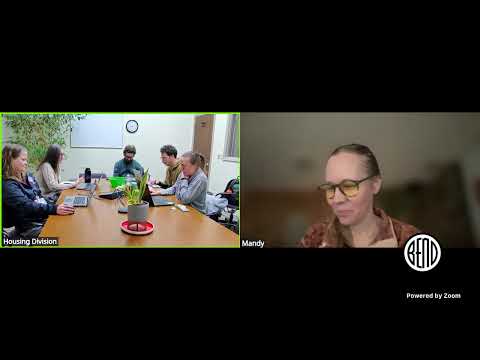
Melissa Kimonya, the City of Bend affordable housing coordinator, opened the Dec. 1 Affordable Housing & Economic (AHEC) subgroup meeting by framing a central choice for reviewers: adopt a numeric scorecard that prescribes funding decisions, or use a review sheet as a discussion tool.
Members cited equity and transparency concerns in supporting the review‑sheet approach. "Some people didn't understand why they were scored highly, but maybe they didn't receive funding," Mandy Dalrymple of AHEC said, urging clarity on how scores would be used. Ian Karras and Todd said scoring typically changes in group discussion and favored a review tool to facilitate deliberation rather than determine outcomes.
Several members favored narrowing rating options to reduce confusion. "Does not meet, meets, or exceeds" was proposed as a simpler alternative to large numeric ranges; Isabel Nokovich said defining concrete examples for each category would help reviewers interpret criteria consistently. Rachel Baker, housing division manager, and others suggested recording brief rationales alongside categorical ratings so applicants can see why reviewers marked a criterion as "meets" or "does not meet."
Staff confirmed the platform (Neighborly) can hold reviewer comments and that staff will check whether draft/non‑submitted reviewer notes can be exported to support deliberations. Melissa said staff will prepare applicant‑facing language explaining the tool's purpose and noted that scores are presented in the application record but that the subgroup's document is intended to guide discussion rather than to be an automatic determinant of awards.
The subgroup did not take formal votes; members agreed to draft language and review criteria changes and present a recommended package to the full AHAC body in January. The subgroup also requested that each scoring category include guidance examples to improve transparency for applicants.
The committee's next steps: staff will collect edits to application questions by Dec. 8; reviewers should finalize draft review criteria by Dec. 29; and the subgroup will meet Jan. 12 to finalize materials for a presentation to AHAC.
This discussion will be presented to the full AHAC body in January for sign‑off or further direction.