Get Full Government Meeting Transcripts, Videos, & Alerts Forever!
Get email alerts on the Building Codes topic
No spam. Unsubscribe anytime.
Denison staff outline plan to adopt 2024 building and fire codes; energy enforcement delayed until March 1, 2026
Summary
City staff told the Denison City Council on Nov. 17 that they plan to adopt the 2024 International Code Council family of building and fire codes with North Central Texas regional amendments, effective Jan. 1, 2026, and a soft transition for the energy code with enforcement beginning March 1, 2026. No formal adoption vote was taken.
Denison City staff presented a package of proposed building and fire code updates to the City Council on Nov. 17, 2025, saying the city should adopt the 2024 International Code Council (ICC) codes with North Central Texas Council of Governments (NCTCOG) amendments effective Jan. 1, 2026, and delay formal enforcement of the energy provisions until March 1 to allow a transition period for builders and permit applicants.
Kirk Kern, who introduced the proposal, said staff had met with local builders, designers and energy raters and received constructive feedback on the changes. "Building codes are the rules that make sure every structure in our city is safe to live in, work in or visit," Kern said, arguing the updates are intended to protect people from preventable hazards and to align Denison with neighboring North Texas municipalities.
Kern said Denison currently relies on the 2018 code editions, with the energy code still at the 2015 edition, leaving the city more than one code cycle behind. He told the council the adoption would restore access to current ICC certification testing for inspectors and protect the city’s Building Codes Effectiveness Grading Schedule (BCEGS) score, which can affect insurance premiums.
The proposed package covers all code families (building, residential, mechanical, plumbing, fuel gas, pools and spas, energy, existing buildings, fire and property maintenance). Kern described a three-month "soft transition" for the energy code: staff will work with permit applicants from Jan. 1 through March 1, and "enforcement of the new energy code won't start until March 1," giving the industry time to adapt to new forms and requirements.
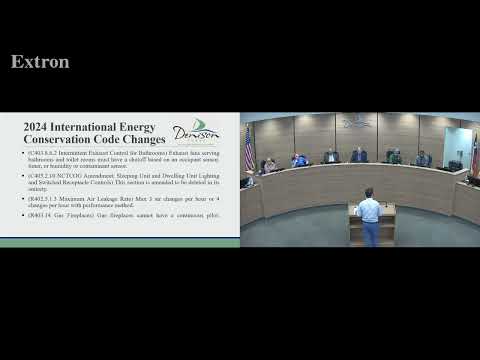
Kern outlined several specific changes the council should expect: revised smoke-alarm placement rules that require installation per manufacturer instructions and to be kept at least 10 feet from cooking appliances; a prohibition on continuous pilot lights for gas fireplaces; new blocking requirements to accommodate future grab bars to support aging-in-place; and energy-code adjustments such as exhaust fans for certain commercial bathrooms that must shut off automatically by timer, humidity sensor or motion sensor.
Kern also summarized commercial-code additions, including a new one-hour fire-rated wood wall assembly option, expanded carbon monoxide detection requirements where CO-producing devices are present, and updated guidance for insulated metal panels and guard requirements for retaining walls. He said the regional NCTCOG amendments aim to keep consistency for builders working across nearby cities.
Harlan, a city staff member who took the council through fire-code provisions, highlighted new standards addressing lithium-ion battery storage and charging. "The lithium ion batteries are a huge issue," Harlan said, describing how large warehouses or storage rooms with batteries can pose a thermal-runaway risk and may require fire suppression, new storage standards, and permitting for high-piled storage. He said EV charging infrastructure rules now include separate disconnects for chargers and location controls to support firefighter response.
Harlan also described requirements for testing radio-communication signals inside large, concrete structures, retroactive carbon monoxide detector requirements for some hotels and apartments (with CO alarms producing a separate signal from fire alarms), and new thresholds for required fire suppression tied to building size. He said the code would impose permitting and annual inspection for high-piled storage above specified heights and require emergency plans and rack-layout documentation.
Kern told the council that staff has posted a proposed code adoption and that, once the council gives direction, staff will publish a list of major changes on the city website to aid builders and permit applicants. When a council member asked which three adjustments would attract the most attention, Kern responded that the energy code changes will likely get the most scrutiny and noted the NCTCOG has provided uniform forms to streamline submittals.
No formal vote on code adoption took place during the meeting. The council had approved the consent agenda earlier in the session and pulled one item (item 4) for a future meeting.
Votes at a glance
- Consent agenda: Motion to approve consent agenda items a–d made by Councilman Redwine, seconded by Councilman Thomas; presiding officer called for the voice vote; motion carried unanimously (exact tallies not specified in the transcript). - Item 4: Pulled for consideration at a future meeting (no final action recorded).
What happens next
Staff said they will post the proposed adoption language and a summary of major changes on the city website and continue outreach to builders before bringing any ordinance or formal adoption to the council. The meeting adjourned after the council declined to hold an executive session and recorded the time as 06:23.