Get Full Government Meeting Transcripts, Videos, & Alerts Forever!
Get email alerts on the Zoning Variance topic
No spam. Unsubscribe anytime.
Conway zoning board denies side-setback variance for 1216 Dunraven Court
Summary
The Conway Board of Zoning Appeals denied a request from Roxanne Kwatek for a 3.5-foot side-setback variance at 1216 Dunraven Court after finding the application did not meet the board’s four-pronged legal test; the board approved routine minutes and closed public input before voting.
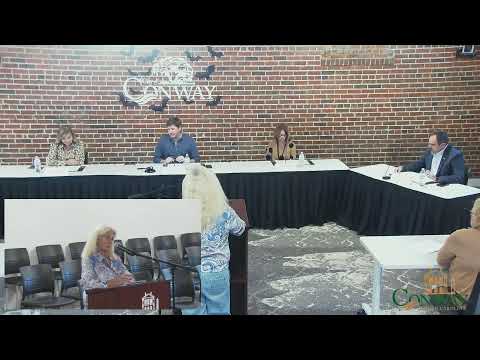
Roxanne Kwatek, the applicant for 1216 Dunraven Court, asked the Conway Board of Zoning Appeals on Oct. 23, 2025, for a 3.5-foot variance to allow a 6.5-foot side setback instead of the 10 feet required by the City of Conway’s Unified Development Ordinance (UDO) Table 6.1. City planning staff described the proposal as an addition to an existing single-family house in the Newcastle subdivision that would encroach into the side setback.
The board reviewed the four legal prongs it must apply — extraordinary conditions, limited applicability to other property, impact on utilization, and lack of substantial detriment to neighbors and the public good — and questioned Kwatek about the property history and site constraints. Kwatek told the board she purchased the home on Oct. 4, 2022, and said she sought the addition on the queried side because the opposite side includes yard not under her control and because the proposed room would provide easier access for family members. As she explained, “She’s got dementia, and she has Parkinson’s,” and another sister has intellectual challenges, which informed the placement of the proposed sitting room.
City planning staff pointed to a 20-foot drainage easement shown on the site plan and told the board that fences are permitted in the easement but structures are not. Staff also noted an addition had been shown on the plan dating to 2020. The presiding board member said that, while the board sympathized with Kwatek’s personal circumstances, the evidence did not satisfy the board’s legal standard: “I really don't think we meet any of the 4 prongs,” the presiding board member said, noting that lots in planned developments tend to have similar configurations and that granting this variance could create precedent that would make it difficult to deny future requests.
After the board closed public input, the presiding board member moved to deny the variance; a second for the motion was recorded for “Mister Hagan,” and a vocal aye vote was recorded (the transcript records City planning staff saying “Aye”). The chair declared the motion carried and the variance denied based on the four-prong analysis.
At the start of the meeting the board approved last month’s minutes on a motion by City planning staff and a second recorded by the presiding board member. Toward the end of the session an adjournment motion was made and seconded, but no vote on adjournment is recorded in the provided transcript.
The board’s decision means the applicant must either revise the design to meet the R‑1 setbacks (20-foot front, 10-foot side, 20-foot rear) or seek another remedy; the transcript indicates the staff had originally denied the building permit because the proposed addition encroached on the side setback and the board affirmed that legal determination.