Get Full Government Meeting Transcripts, Videos, & Alerts Forever!
Get email alerts on the Parking Regulations topic
No spam. Unsubscribe anytime.
El Campo staff proposes 20-foot cap, clearer RV definition and corner-yard ban to curb oversized vehicles in residential areas
Summary
City staff recommended expanding the RV parking ordinance to cover trailers, boats and oversized commercial vehicles, suggested a 20-foot maximum length and proposed a corner side-yard restriction; councilmembers asked staff to refine definitions and enforcement logistics, with no vote taken.
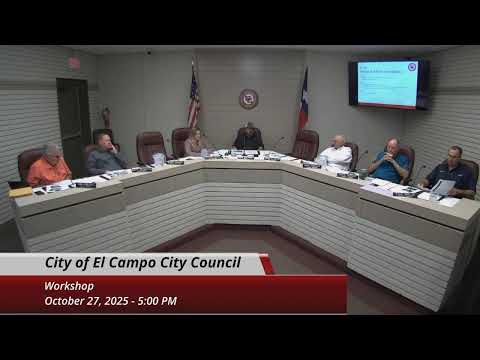
El Campo staff presented a package of proposed edits to the city's parking rules on Oct. 27, urging the council to consider adding clear length limits, expanding the ordinance beyond recreational vehicles and tightening rules for corner side yards.
Staff presenter (Speaker 3) told councilmembers the existing ordinance applies only to RVs and recommended adding language to explicitly include oversized and commercial vehicles, trailers, boats and boat trailers. "I've included that for you guys," Speaker 3 said, explaining the packet shows additions in green, deletions in red and discussion notes in yellow.
The staff report and packet refer repeatedly to length-based definitions. As an example for council consideration, Speaker 3 proposed a 20-foot maximum for trailers: "I put an example of 20 feet in there for you," she said. Several councilmembers and participants supported using length as an enforcement metric rather than ad-hoc judgments about appearance.
Councilmembers raised practical questions about how to classify very large commercial vehicles, such as 18-wheelers and bobtails, and whether to rely on length, weight or commercial registration. One participant recommended using vehicle registration (EVWR) to determine class: "I would suggest by weight, go by EVWR so that we run a registration on it," said Speaker 1.
Staff flagged a sight-line safety concern for corner lots and proposed language to prohibit oversized vehicles in corner side yards so vehicles must remain behind the front and side setbacks. "If the side of the house is actually a corner and there's a street right there, it could potentially be a visibility issue," Speaker 3 said.
On enforcement, Speaker 3 cautioned the city has limited capacity and outlined the approach used when the RV rule was first adopted: an initial three-month education rollout including door knocks and bilingual flyers rather than immediate citations. "When we saw RVs parked, we would knock on the door, leave a flyer, talk to them, tell them what they had to...we weren't, like, initially going out and writing violations immediately," she said. Staff also noted a state-law implication: if a change requires property owners to build curb cuts or parking pads, the city would be required by state law to pay for those improvements.
Councilmembers and residents emphasized enforceability and fairness. Speaker 6 observed that distinguishing overnight commuting from long-term storage can be difficult: "I park it there at night, and the next morning, I go to work. So that isn't storage or long term parking," he said. Several members asked staff to return with clarified definitions, proposed thresholds (including the 20-foot example), and a plan that balances complaint-driven enforcement with realistic administrative capacity.
No formal motion or vote was taken. Staff said they would update the commercial-vehicle definition, revisit packet language with the enforcement team, and accept emailed feedback from councilmembers on specific thresholds such as length and any weight-based alternatives.
Next steps: staff will draft ordinance language reflecting council direction, include enforcement logistics and regulatory thresholds, and return for further consideration at a future meeting.