Get Full Government Meeting Transcripts, Videos, & Alerts Forever!
Get email alerts on the Comprehensive Plan topic
No spam. Unsubscribe anytime.
East Lansing planning commission reviews 2025 comprehensive plan update emphasizing housing, equity and resilience
Summary
The Planning Commission held a deep-dive on the draft 2025 Comprehensive Plan on Nov. 19, 2025, focusing on housing choice, social equity, public health and climate resilience and directed staff to advance implementation steps including zoning updates and a future land use map review.
Landon Bartley, planning staff, presented a detailed review of the draft 2025 Comprehensive Plan to the East Lansing Planning Commission on Nov. 19, emphasizing social equity as the document’s guiding lens and highlighting housing, public health and climate resilience as priority focus areas.
Bartley said social equity emerged as the top priority from early community engagement: “Social equity was the number 1 priority of folks,” and he urged commissioners to consider equity explicitly in implementation choices. He said the plan is an update, not a replacement of the 2018 plan, and that implementation — not the document itself — will determine whether equity goals are met.
The presentation combined demographic data and community input. Bartley cited 2022 census-derived indicators for East Lansing, including a median age of about 21.4 years, a historic job-to-housing ratio near 1.39 and a median family income of roughly $121,000, while noting material income gaps: “BIPOC families earn on average $30,000 less than white families,” he said, and that median household income for BIPOC households was substantially lower than for white households.
Housing dominated the discussion. Bartley summarized the plan’s housing goal as expanding housing choices through “appropriate and thoughtful density” and called out “missing middle” types (duplexes, triplexes, fourplexes, townhouses and accessory dwelling units) as tools to diversify supply. He urged limiting greenfield development in the northern tier and concentrating new housing near downtown and major corridors to take advantage of existing infrastructure and transit.
Commissioners and staff discussed university-owned student housing, including Spartan Village, and its effects on local supply. Several commissioners questioned population and student-enrollment projections used in the plan and cautioned against assuming future growth without corresponding housing production.
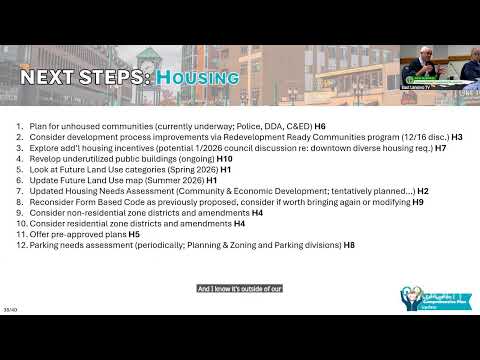
On implementation, Bartley outlined near- and mid-term actions: updating the future land use map (potentially next spring), reviewing the housing needs assessment, zoning updates to enable a broader mix of housing types, streamlining development processes and piloting preapproved plans for missing-middle housing. He also described incentives for attainable housing and options to support aging in place.
Public health and climate resilience chapters were presented as integrated with housing decisions. Bartley described built-environment strategies — improving sidewalks and crosswalks, increasing tree canopy, conducting accessibility audits and advancing green infrastructure — as ways to reduce health risks and boost resilience to flooding and heat events. He noted the city’s wet-weather resilience plan being developed by public works and said stormwater policy changes are expected to come to council for discussion in December.
Commissioners praised the student engagement effort and suggested the commission adopt a more proactive posture on specific implementation items such as accessory dwelling units (ADUs), form-based code review and future land use updates. Bartley said staff would return with concrete proposals and that some items — like a parking needs assessment — are already underway.
The commission did not take a final vote on the plan at this meeting; members directed staff to prioritize near-term implementation steps and provide follow-up materials to help the commission and council evaluate zoning amendments and other actions.
What’s next: staff plans to bring targeted zoning and implementation proposals to the commission and to the council over the coming months, beginning with a potential future land use map update and additional detail on ADUs and development-process improvements.