Get Full Government Meeting Transcripts, Videos, & Alerts Forever!
Get email alerts on the Pedestrian Safety topic
No spam. Unsubscribe anytime.
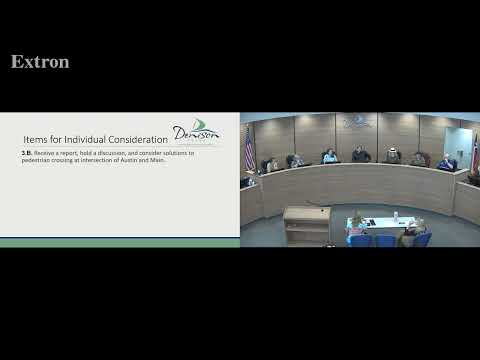
Denison Main Street Advisory Board discusses Austin–Maine crosswalk, recommends routing safety options to city leadership
Summary
Members reviewed safety concerns after the fall festival moved activities away from the 100 block, discussed short-term measures (signage, flashing message boards, hiring officers or shuttles) and agreed to refer the issue to the city manager for follow-up. No formal engineering change was approved.
At its meeting, the Main Street Advisory Board in Denison discussed safety and pedestrian-flow problems at the Austin and Maine intersection after multiple speakers said the crosswalk and traffic routing contributed to lower foot traffic on the 100 block during a recent fall festival. "I received a phone call from the Red River Railroad Museum, Sam Oswald, and to get traffic across," Speaker 7 said, describing merchant concerns that festival activity did not draw visitors into businesses.
Board members and business owners described several short-term and interim fixes, including advance banners and signs warning of festival activity, the use of flashing message boards, and hiring certified officers to staff crossings for major events. Speaker 4 said volunteers are frequently ignored by festival attendees and argued that "if it was a real police officer walking people across, I don't think people would threaten to beat them up," underscoring tensions about volunteer marshals. Speakers also proposed shuttle or trolley services to move people between the 100 and 200 blocks on event days.
Beyond temporary measures, members raised traffic-engineering options — funneling lanes during events, using flashing-red schemes or lengthening signal cycles to increase pedestrian crossing time — but cautioned that changes affecting state highways would involve TxDOT and long planning horizons. Speaker 7 noted TxDOT requires an alternate route in case of incidents on the highway, which limits what TxDOT will allow and often means the city remains the decision-maker on local interventions.
No formal motion to change traffic engineering was adopted. When S1 asked whether a motion was needed to send the matter to council, the group agreed it should begin with the city manager and leadership: "I don't think it's a council. I think we need to, you know, go to the city manager," Speaker 3 said. The board recorded consensus to refer the matter to city leadership so staff can evaluate short-term solutions and the likely budget implications of any permanent changes.
Next steps: staff or the city manager will be asked to return with options and costs for low-cost signage and officer staffing for festival days; any high-cost infrastructure or re-routing that affects TxDOT-controlled roadway alignments would need further study and council action.