Get Full Government Meeting Transcripts, Videos, & Alerts Forever!
Get email alerts on the Impact Fees topic
No spam. Unsubscribe anytime.
El Paso Water reports $1.8 million in March–August collections; staff to design credits under new state law
Summary
El Paso Water told the Capital Improvements Advisory Committee it collected about $1.8 million in impact fees from March to August 2025 and has spent millions on projects including the Pure Water Center; staff said they are developing a process to implement credits authorized by Senate Bill 14.
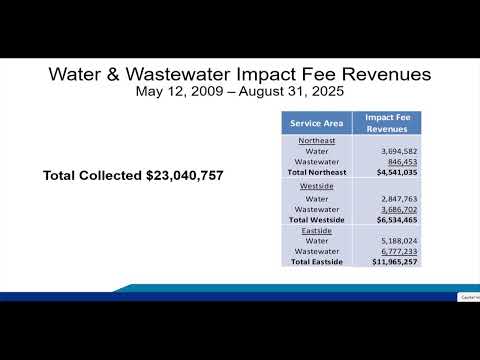
El Paso Water officials reported to the Capital Improvements Advisory Committee that the utility collected about $1.8 million in impact fees between March 1 and Aug. 31, 2025, and that life‑to‑date impact‑fee reserves stand at roughly $23 million. Gustavo Hurtado, fiscal operations manager for El Paso Water, said the East service area accounts for the largest cumulative collections.
Hurtado told the committee the utility is spending heavily on capital projects needed to serve growth. He said the Pure Water Center accounted for the largest increase in expenditures during the reporting period, with about $22.3 million recorded for that project in the most recent six months. He also cited the Franklin East Transmission Main (budgeted at roughly $37 million, with about $12.8 million spent to date) and the Bustamante wastewater treatment plant (about $14 million spent in the period).
The presentation outlined program totals reported by El Paso Water: a water‑project program budget reported at about $521 million (life‑to‑date spending reported around $137 million) and a wastewater program budget reported at about $727 million (life‑to‑date spending reported around $134.3 million). Committee members pressed staff on apparent inconsistencies between itemized project lines and the aggregate budgets; Hurtado said some older projects were completed under prior budgets and therefore may appear without an active line‑item budget in the newest report.
Committee members focused significant attention on a new state law, Senate Bill 14, which Hurtado said authorizes local governments to provide credits against water and wastewater impact fees when a developer dedicates eligible facilities or systems that result in water reuse, conservation or savings. "It has to have that kind of system," Hurtado said, describing credits for projects that conserve or reuse water. Renata Aranova of El Paso Water Planning and Development said the state rule is expected to take effect in January and that the utility is working to define local criteria for credits.
Jeff Tepzik, chief financial officer for El Paso Water, cautioned that local impact‑fee rates had been set below consultant recommendations and that developers will weigh the cost of installing conservation systems against the size of any credit: "Is it really cost effective? Am I going to spend $5,000 to save $200 on an impact fee?" Tepzik said, adding that the utility may not meet a Jan. 1 implementation deadline but expects any local policy to be retroactive where applicable.
Staff said credits will apply only within existing impact‑fee service areas (West, Northeast and East) and will be awarded based on locally developed criteria; they emphasized the policy is in early stages and that El Paso Water and city staff are working with rate consultants and peer cities to design an evaluation process. Committee members asked whether the state law allows credits for economic development or community‑impact factors; Tepzik said the statute is narrowly focused on conservation.
After questions, the committee voted to approve the semiannual impact‑fee report and filing required under state law. Members also instructed staff to continue developing the local crediting mechanism and to return with further details at a future meeting.
The committee established a timeline for next steps: staff will work with consultants and peer cities to draft implementation procedures and present findings to the committee at upcoming meetings.