Get Full Government Meeting Transcripts, Videos, & Alerts Forever!
Get email alerts on the Land Use topic
No spam. Unsubscribe anytime.
East Lansing commission hears split public reaction to Sheetz plan at Saginaw and Abbott; requests updated traffic and stormwater data
Summary
The Planning Commission on Oct. 8 heard a Sheetz request to build a 6,139-square-foot store with an eight-pump fuel canopy at 111 E. Saginaw St. Commissioners and residents pressed for an academic-year traffic study, a stormwater management plan, police input on late-night operations and clearer pedestrian and bike accommodations; the item will return Oct. 29.
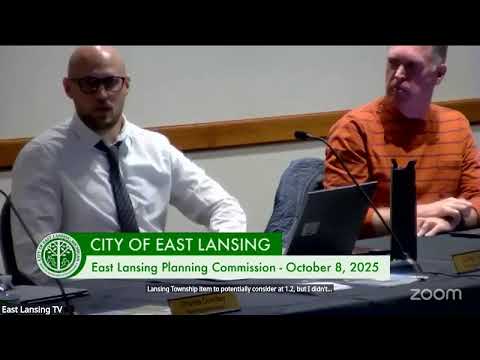
The East Lansing Planning Commission heard hours of testimony Oct. 8 on a Sheetz proposal to redevelop the former Rite Aid site at 111 E. Saginaw St. into a 6,139-square-foot convenience store and restaurant with a drive-through and an eight-pump fuel canopy.
Planning staff described the property as a 2.135-acre parcel and said the proposal includes 16 fuel handles, 30 interior seats and 16 outdoor seats, 39 parking spaces (34 required), one EV-capable stall, 29 replacement trees and fully shielded lighting. Alicia Wright, a planner with the city, told commissioners the plan meets applicable ordinance dimensions for signage and lighting and that drive-throughs and auto service stations require a city council special-use approval following the commission’s recommendation.
The applicant, Alex Sawicki of Sheetz, outlined the company’s in-house operations and said the convenience lane (called a drive-through under zoning) produces low volumes — about eight vehicles in the peak lunch hour — and that Sheetz will comply with city engineering requirements for soil erosion, stormwater detention and water quality. “We will fully comply with all the city standards when it comes to soil erosion, protections and ongoing operations,” Sawicki said.
That assurance did not quiet critics. Commissioners and residents repeatedly asked for an updated traffic-impact study collected while Michigan State University students are in session, saying summer counts can understate queuing and pedestrian interactions. Commissioner Putz and others said they wanted a study that captures typical academic-year conditions; several speakers from the public echoed that point.
Several residents also raised pedestrian and bicycle safety concerns, saying the applicant’s packet lacked analysis of pedestrian crossings and bike accommodations at the busy Saginaw–Abbott intersection. Tim Rzowski, a resident who reviewed the packet, praised staff’s stormwater review but said the traffic and queuing analysis needed expansion. “I think the queuing study is really important and I think the traffic study probably needs to be reconsidered or added to, to consider traffic during the school year,” he said.
Other speakers questioned whether East Lansing needs another fuel-and-convenience site. Mary Ann Stowe of the White House neighborhood called the proposed building "gaudy" and accused the corporation of taking advantage of the city’s municipal needs: “The corporation smelled blood in the water,” Stowe said. Opposing comments also raised long-term concerns about fossil-fuel sites and future cleanup liabilities.
Some neighbors and local operators said a replacement gas station fits the historic pattern for the corner and could provide late-night service residents lack. Jack West, president of a neighborhood association and a Lansing resident, spoke in favor of the project, citing store hours and made-to-order food offerings popular with shift workers and students.
Commissioners asked the applicant to pursue several follow-ups before the commission takes a recommendation to council: an updated traffic-impact study collected during the academic session, a stormwater-management plan or engineer response addressing site runoff and erosion, clarification on pedestrian and bicycle accommodations (including potentially more bike parking), notice to adjacent property owners and the city’s police department’s perspective on late-night operations. Staff said they would coordinate with the applicant and city engineering and policing units.
Chair Sullivan closed the hearing and said the item will return to the Planning Commission on Oct. 29 for further consideration. No final decision or formal vote on the special-use permit was made Oct. 8.
Procedural business at the meeting included approval of the agenda and prior minutes, staff reports on committee activity and approval of minor calendar changes; commissioners voted to reschedule Nov. 12 to Nov. 19 and Dec. 10 to Dec. 17 to accommodate member conflicts.