Get Full Government Meeting Transcripts, Videos, & Alerts Forever!
Get email alerts on the Stormwater Veterans Home topic
No spam. Unsubscribe anytime.
Gallatin council weighs three‑option fix for stormwater flooding at American Legion veterans residence; ARPA deadline complicates choice
Summary
After public comments from a veteran asking for fee refunds, city staff told the Gallatin City Council there are three realistic options to fix chronic flooding at the American Legion veterans residence: proceed with the originally designed Hill/Hale Avenue extension, build a new detention pond on Liberty Baptist Church land, or return $500,000 in ARPA funds and redesign. Time limits on the federal funds and property access issues, including the church’s reluctance and possible condemnation of a small parcel, shaped the debate and a decision to revisit the matter at the Dec. 9 work session.
A special council work session on stormwater in Gallatin turned toward hard tradeoffs on how to use $500,000 in ARPA funds to address chronic flooding at the American Legion veterans residence.
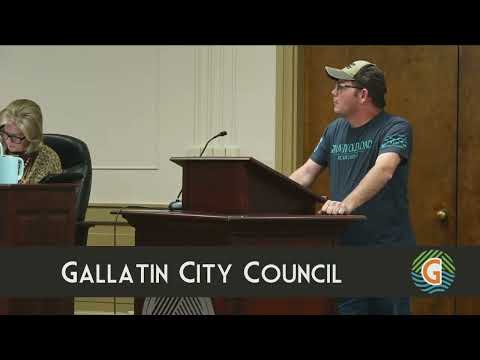
Chris Shoemaker, a veteran who identified himself as a "7 year US army vet, 100% disabled," told the council the Legion has paid stormwater fees for years and asked for a refund of $11,371 so the group could contribute to remediation coordinated with the city and neighboring property owners. "I'm asking that you consider the stormwater refund," Shoemaker said during public recognition.
City staff summarized their technical review and schedule constraints. "There's only 3 valid options to move forward," Mr. Tuttle told the council: (1) proceed with the previously designed Hill/Hale Avenue extension that would remove Woods Ferry Road and expand detention at Bell/Bale Street; (2) build a roughly 100‑foot‑wide detention pond on Liberty Baptist Church land just north of the veterans residence (staff said church negotiators would not agree to a large footprint); or (3) give the $500,000 back to the county and seek another solution. Tuttle emphasized the time pressure tied to the ARPA allocation and the engineering and legal constraints around natural‑flow drainage rules.
Council members focused on how much detention capacity was required, whether a narrower pond footprint (35–50 feet) could work, or whether deeper excavation would be an adequate substitute. Staff said narrower footprints would require deeper excavation, retaining walls or blasting in some locations and would likely be much costlier and riskier to construct. Tuttle also noted the city had performed subsurface exploration on the Veil/Bell Street pond site but not on church property, increasing uncertainty if the design moved to that parcel.
Public‑safety and access concerns also framed the choices. Police and fire officials, according to staff, opposed removing Woods Ferry Road without a viable alternative because routing emergency vehicles around neighborhoods would extend response times. Staff repeatedly cited Tennessee’s natural‑flow rule and warned that work that increases downstream flow could expose the city to legal claims.
Negotiations with Liberty Baptist Church had not produced the larger easement staff said would make the church parcel the lower‑risk design option; staff said condemnation of roughly three‑tenths of an acre would be required if the city pursued the road extension solution and could not secure access. "We either need to give the money back or be prepared to move forward with a solution that does require apparently condemnation," Tuttle said.
Council members asked staff to prepare more comparative numbers for a 50‑foot vs. 100‑foot pond and raised the public comment about refunding stormwater fees paid by the Legion. After debate, members voted to place the item on the Dec. 9 work session for further review and to get the requested comparative figures; at least one member stated opposition to moving forward without those numbers.
What happens next
Staff agreed to provide the requested comparative modeling and cost information for narrower footprints and to return the item to the Dec. 9 work session for further direction. Staff and council also noted procurement and reporting deadlines tied to ARPA funds — design, construction and invoices must meet the reporting schedule, and staff said the fiscal closeout for the program is expected by 12/31/2026. The council did not authorize condemnation at this meeting; any formal condemnation action would require a separate council resolution and votes at a publicly noticed council meeting.
Why it matters
The debate affects veterans who live in a city facility where repeated flooding complaints have persisted for years, the owner of adjacent church property, and downstream residents in Hellwood Estates who could see changes in flood risk depending on how detention and piping are reconfigured. The decision also implicates federal ARPA funds, project procurement timelines and the city’s legal exposure under state drainage rules.