Get Full Government Meeting Transcripts, Videos, & Alerts Forever!
Get email alerts on the Comprehensive Plan Housing topic
No spam. Unsubscribe anytime.
Cranston staff outlines housing plan to meet state targets, commission hears questions on feasibility
Summary
Cranston planning staff presented a Phase 2 housing element that lays out strategies to meet a state-derived target for 2030, prompting debate over projected unit counts, the treatment of small/oversized lot rules and how to protect commercial land while expanding housing.
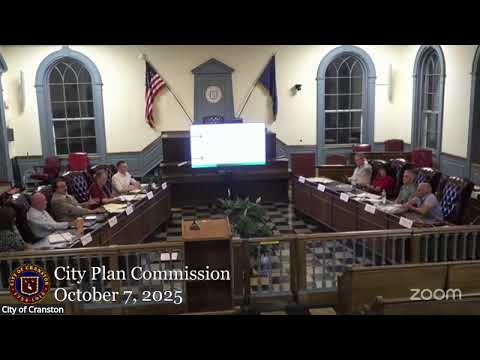
Cranston planning staff on Wednesday presented a draft Phase 2 housing element that aims to show how the city could meet the state’s housing-production expectations, including a 2030 target the staff described as roughly 1,367 units. Director Ashman told the Planning Commission the staff will circulate a draft in advance of the next meeting and submit an initial housing element to statewide planning for review.
“Moving full speed ahead with comp plan phase 2 as well as expediting work on the housing element,” Director Ashman said, adding the intent “is to submit this element to statewide planning directly as a draft for review, while we continue to work on all the other elements of the comp plan.” (Director Ashman first appears in the transcript at SEG 1033.)
Why it matters: the housing element will determine where Cranston proposes to accommodate additional housing and which ordinances the city would change to comply with state expectations. The draft presented to the commission included three broad strategies: concentrating growth in transit-supportive corridors (Warwick Avenue, Broad Street, Elmwood Avenue), allowing neighborhood mixed-use rezonings in selected areas, and encouraging “unrealized growth” (infill and lot splits, accessory dwelling units and adaptive reuse).
Supporters and staff said the changes are designed to address a long-running shortfall in new units since the 2008 downturn. Ashman’s presentation included historical permit data and projected production through 2046 and described a need to ramp up building in coming years to “catch up.” She emphasized the staff’s work to align local rules and to prepare ordinance text that will be considered in coming weeks.
Commissioners pressed staff on the assumptions behind the production numbers, the analytic area for small‑lot or lot‑split rules and the risk of losing commercial or industrial land to housing. Commissioner Windsor asked whether the source of units mattered: “If we get to that 13 67, it doesn't necessarily matter how from which category those homes come from,” he said, summarizing the broader debate that a surge in housing in one category could reduce production in another.
Staff acknowledged gaps and differences between the subdivision rules and the zoning ordinance on how to calculate usable area (for example, whether overhead utility easements or wetlands are excluded), and they pledged to align the definitions and to provide clearer guidance before a formal vote. Ashman also said the city has identified roughly 800 lots that could theoretically be split under the state’s lot‑split rules, but cautioned that a blanket assumption that every qualifying lot would be developed would overstate near‑term production.
The commission asked staff to provide overlay exhibits showing prior approvals alongside proposed changes, clarification of the state‑draft target the city must address, and a clearer accounting of how many units are already approved but not yet built. Director Ashman said staff will circulate a revised draft and related ordinance text and recommended continuing the public hearing to allow additional technical review.
Next steps: the commission voted to continue the comprehensive plan amendments public hearing to Nov. 4 to allow staff to deliver revised materials and to respond to commissioner questions. (Public hearing continued; no final vote on the plan was taken.)